
Key Takeaways
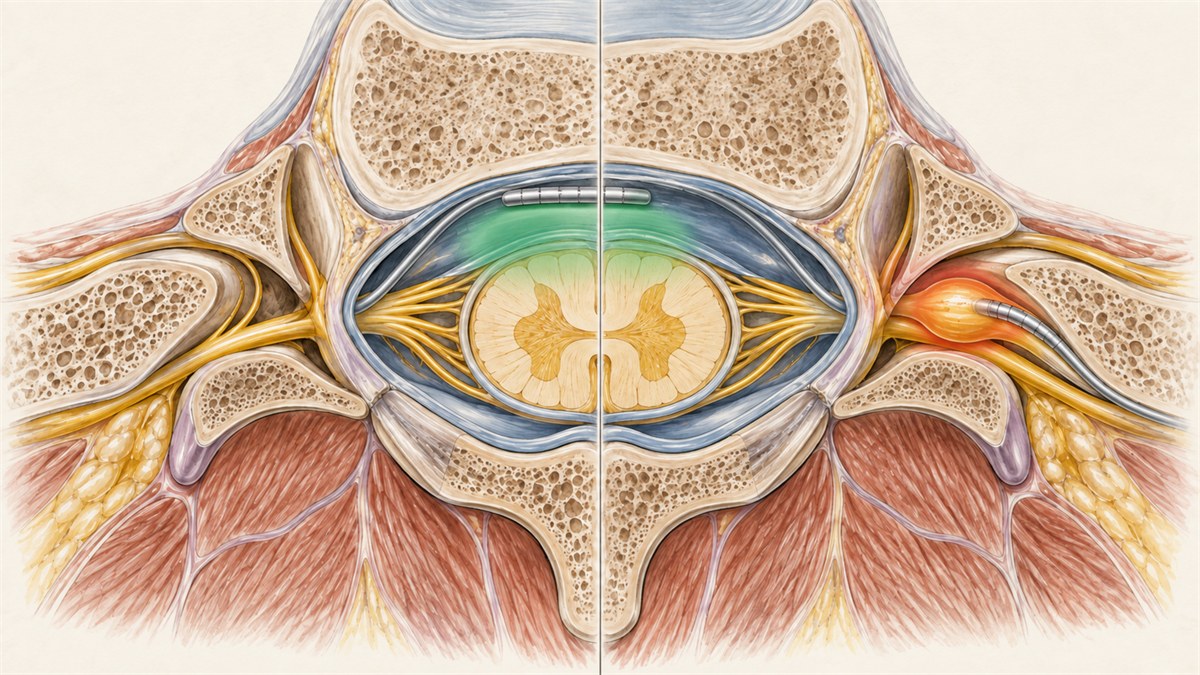
- SCS typically places leads in the epidural space to influence spinal cord pathways; DRG stimulation targets dorsal root ganglia associated with more specific regions.
- A comparative randomized trial supports DRG stimulation for the trial’s studied population—lower-extremity CRPS or causalgia—but does not establish that DRG is better for every pain condition.
- Selection, psychosocial screening, expectations, and a temporary trial are important parts of neuromodulation planning.
- Neither therapy repairs the original tissue problem or guarantees pain relief; both require ongoing device and clinical follow-up.
Two forms of neuromodulation
Spinal cord stimulation and dorsal root ganglion stimulation are forms of neuromodulation. Thin leads are placed in the epidural space and connected to a pulse generator. The electrical field is programmed to alter pain-signal processing rather than remove a disc, reverse nerve injury, or erase a diagnosis.
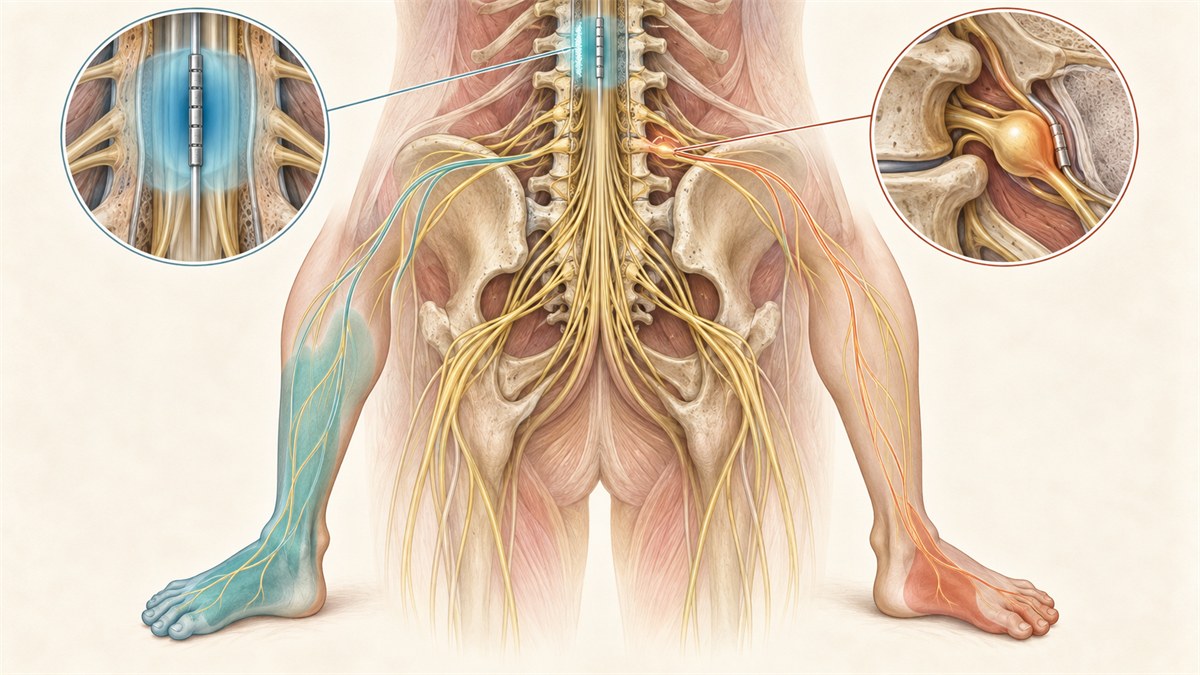
Traditional SCS targets dorsal-column pathways and can address broader pain distributions. DRG stimulation places leads near selected dorsal root ganglia, structures that help relay sensory information from defined body regions. That more focal anatomical strategy can be useful when pain is concentrated in a difficult-to-cover area, but anatomy alone does not decide candidacy.
What the head-to-head evidence can tell us
The ACCURATE randomized comparative trial enrolled people with chronic lower-extremity pain due to complex regional pain syndrome or causalgia. Within that population and study design, DRG stimulation met the comparative endpoint and produced higher treatment-success rates than conventional SCS at three and 12 months, with less postural variation in paresthesia.
That result is clinically meaningful and also bounded. It should not be generalized to every neuropathic pain diagnosis, every body region, every SCS waveform, or every patient. Technology has also evolved since the trial. Evidence should be matched to the condition being considered.
The trial is part of the decision—not the whole decision
Consensus guidance recommends a stimulation trial before permanent SCS implantation in most chronic non-cancer pain indications. The temporary phase lets a patient experience stimulation and allows the team to assess pain, function, medication goals, sleep, activity, and tolerability against expectations set in advance.
Screening is broader than pain intensity. Diagnosis, previous treatment, anatomy, medical risk, psychological and social factors, the ability to operate and charge a system, follow-up access, and realistic goals all matter. Guidelines specifically emphasize validated psychosocial screening, including assessment for depression.
Questions that sharpen the comparison
Ask which diagnosis the team is treating, why the proposed target fits the pain distribution, what evidence applies to that diagnosis, how trial success will be defined, and which functional goal matters most. Discuss lead location, recharge or battery choices, MRI conditions, activity restrictions, driving, infection and bleeding risk, revision or explant possibilities, and who provides long-term programming.
It is also reasonable to ask what happens if the trial is inconclusive. A failed trial does not mean the pain is not real, and a successful trial does not guarantee the same benefit indefinitely.
Evidence context
For selected patients, both SCS and DRG stimulation can be reasonable options. The strongest comparative claim should remain narrow: DRG performed better than conventional SCS in a specific randomized population. Beyond that, diagnosis, pain geography, evidence, technical feasibility, preferences, and longitudinal support guide the choice.
References
- Dorsal root ganglion stimulation yielded higher treatment success rate for complex regional pain syndrome and causalgia at 3 and 12 months: a randomized comparative trial. Pain, 2017.
- Evidence-based consensus guidelines on patient selection and trial stimulation for spinal cord stimulation therapy for chronic non-cancer pain. Regional Anesthesia and Pain Medicine, 2023-03-30.