
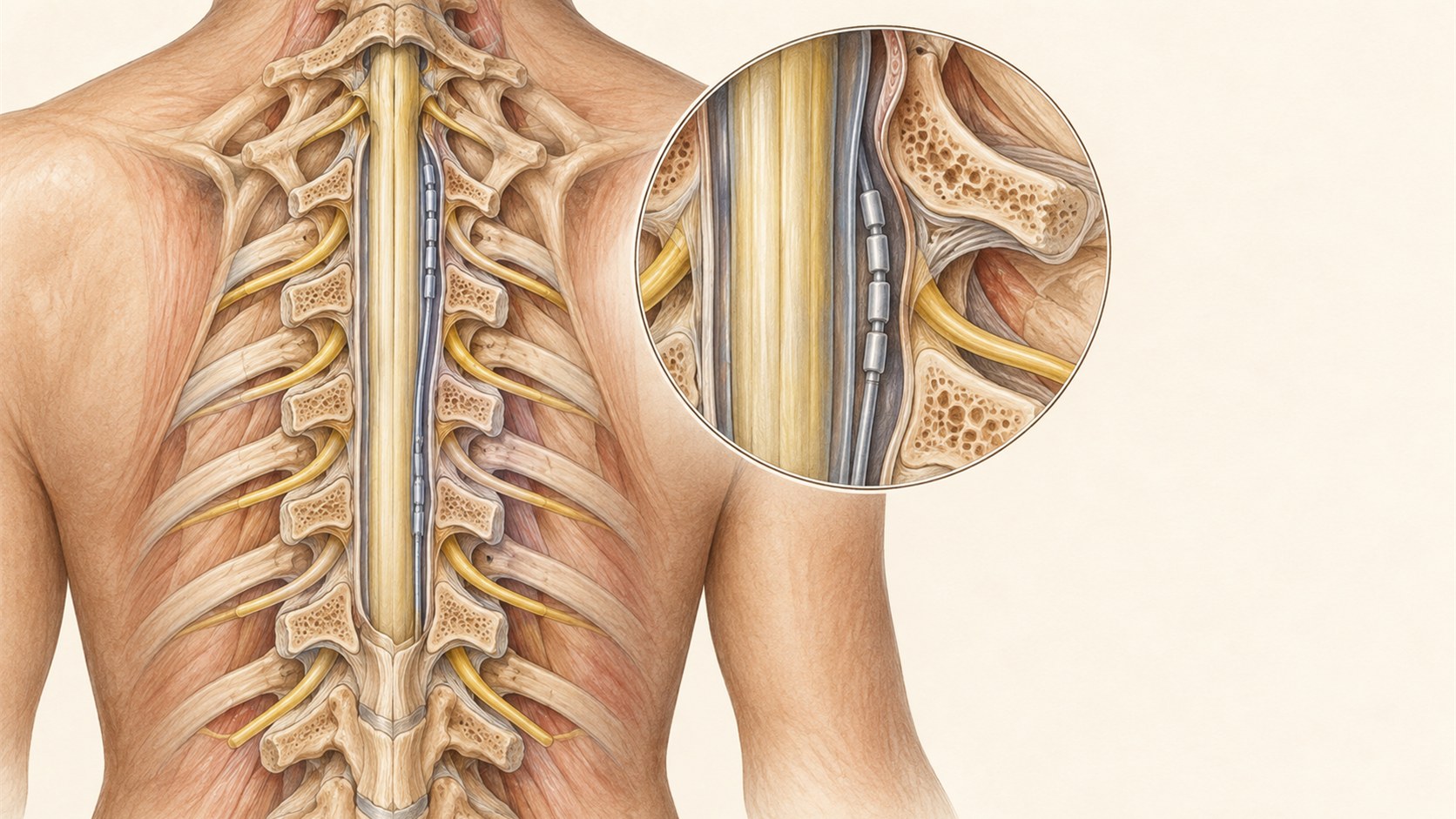
The target is near the spinal cord, not a single peripheral nerve.
Neuromodulation
Spinal Cord Stimulation
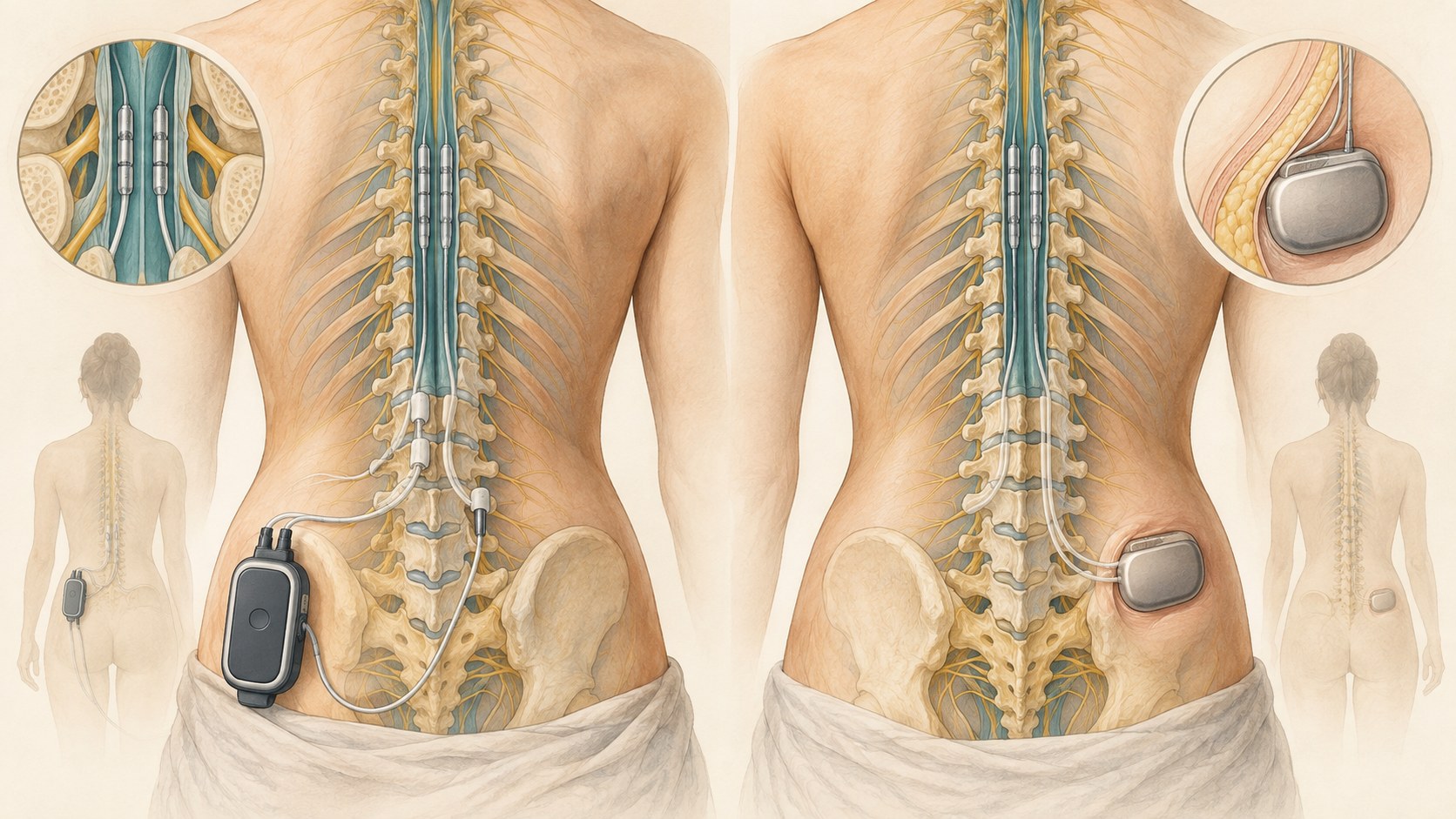
Spinal cord stimulation uses leads in the epidural space to change pain signaling. It may be considered for selected chronic neuropathic pain patterns, but the diagnosis, prior care, goals, and risks must be reviewed before a trial.
Quick orientation
What to know first
A temporary trial tests a defined functional goal before permanent implantation is considered.
Evidence depends on the diagnosis; durable benefit and complication risk remain individual.
Learn what may come next
Related guides.
Use these links to learn about related symptoms, conditions, and treatments. An individual evaluation is still needed to determine a diagnosis or whether a treatment may be appropriate.
Care overview
Neuromodulation
Compare approved neuromodulation pathways and understand how modality selection differs by diagnosis, anatomy, and goals.
Open this guideSpecific treatment
Dorsal Root Ganglion (DRG) Stimulation
Understand DRG stimulation for selected focal neuropathic pain presentations, including trial and selection context.
Open this guideSpecific treatment
Peripheral Nerve Stimulation
Understand peripheral nerve stimulation for selected named peripheral-nerve pain presentations.
Open this guideSpecific treatment
Vagus / Auricular Neuromodulation
Understand the actual nontraditional vagus/auricular neuromodulation service offered by the practice without implying implanted cervical VNS for epilepsy.
Open this guideTarget and mechanism
The target defines the modality
Thin leads are positioned in the epidural space near the spinal cord. Stimulation patterns are programmed to influence pain signaling. The exact lead level and system are chosen for the clinical target and are not interchangeable with DRG or PNS.
Patient selection
Selection questions
These questions help determine whether the proposed neural target and treatment plan fit the individual problem.
A confirmed chronic neuropathic pain pattern with symptoms that match the proposed target
Meaningful limits despite appropriate nonoperative and other indicated care
Realistic, measurable goals for function, sleep, medication burden, or activity
Ability to participate in trial assessment, wound care, programming, and follow-up
A staged decision
How we decide what may come next
Evaluation includes diagnosis confirmation, review of imaging and prior care, psychosocial and medical risk assessment, and a discussion of alternatives. A temporary trial is usually performed first. Permanent implantation is considered only if the trial meets the agreed goals and no new concern changes the balance.
Related care
Conditions this treatment may be considered for
These related guides show educational connections. They do not establish candidacy, a recommendation, or a required sequence.
Therapeutic Consideration
Persistent Post-Surgical Spine Pain
May be considered within a trial-based neuromodulation pathway after cause-oriented reassessment and selection.
Explore this pageTherapeutic Consideration
Painful Diabetic Neuropathy
May be considered within an approved-label, trial-based neuromodulation pathway after diagnosis and selection.
Explore this pageTherapeutic Consideration
Complex Regional Pain Syndrome
May be considered within a trial-based neuromodulation pathway after multidisciplinary diagnosis and selection.
Explore this pageDecision process
Decision sequence
The safest sequence starts with diagnosis and target, then compares alternatives and evidence, and only then considers a trial, temporary treatment, or implant.
Set specific trial goals before the procedure
Use the trial period to test activity and function, not pain score alone
Review trial results and adverse effects before any implant decision
Evidence at a glance
Evidence at a glance
Evidence must be matched to the exact diagnosis, comparator, follow-up period, and system studied.
Randomized evidence supports SCS for selected persistent neuropathic leg pain after spine surgery and for refractory painful diabetic neuropathy.
Evidence for nonspecific low back pain is more uncertain and placebo-controlled reviews raise important limitations.
Long-term benefit may diminish, and infection, lead migration, revision, and explant are material considerations.
Decision quality matters
Evidence, limits, and who it may fit
Relationship membership does not establish candidacy. Published results must be qualified by selection criteria, study design, durability, complications, and alternatives.
Risks and limits
Evidence, risks, and limits
Randomized evidence supports SCS for selected persistent neuropathic leg pain after spine surgery and for refractory painful diabetic neuropathy. Evidence for nonspecific low back pain is more uncertain and placebo-controlled reviews raise important limitations. Long-term benefit may diminish, and infection, lead migration, revision, and explant are material considerations.
A successful trial does not guarantee permanent benefit.
The system can require reprogramming, revision, or removal.
MRI compatibility and future procedures depend on the exact system.
New weakness, infection signs, or device problems require prompt clinical contact.
The visit
What to expect from an evaluation
The visit should identify the diagnosis, the proposed neural target, the evidence that applies to that exact condition, alternatives, and a measurable next step.
Common questions
Spinal Cord Stimulation FAQ
These answers are educational and cannot determine an individual diagnosis or treatment plan.
What is the difference between the trial and implant?
The trial uses temporary leads and an external controller for a limited assessment. A permanent system places the pulse generator under the skin.
Does a successful trial guarantee long-term relief?
No. It can inform the decision, but benefit can change and device-related problems can occur later.
Is SCS only for pain after spine surgery?
No. It may be considered for several selected neuropathic pain indications, but evidence and regulatory status differ by diagnosis.
Target before technology
Start with a target-specific consultation
A consultation can clarify whether this modality, another treatment, or continued diagnostic work is the appropriate next step.