
RFA is a family of target-specific procedures, not one interchangeable treatment.
Treatment family
Radiofrequency Ablation
Radiofrequency ablation, or RFA, is a family of procedures that uses controlled radiofrequency energy near selected neural targets. The intended target, clinical question, selection pathway, technique, and risks differ from one RFA procedure to another.

Quick orientation
What to know first
Cervical and lumbar facet RFA commonly use medial branch blocks for selection; that pathway does not apply to every RFA target.
RFA may change selected pain signaling, but it does not repair arthritis, discs, stenosis, or other structural disease.
One family, different targets
What radiofrequency ablation does
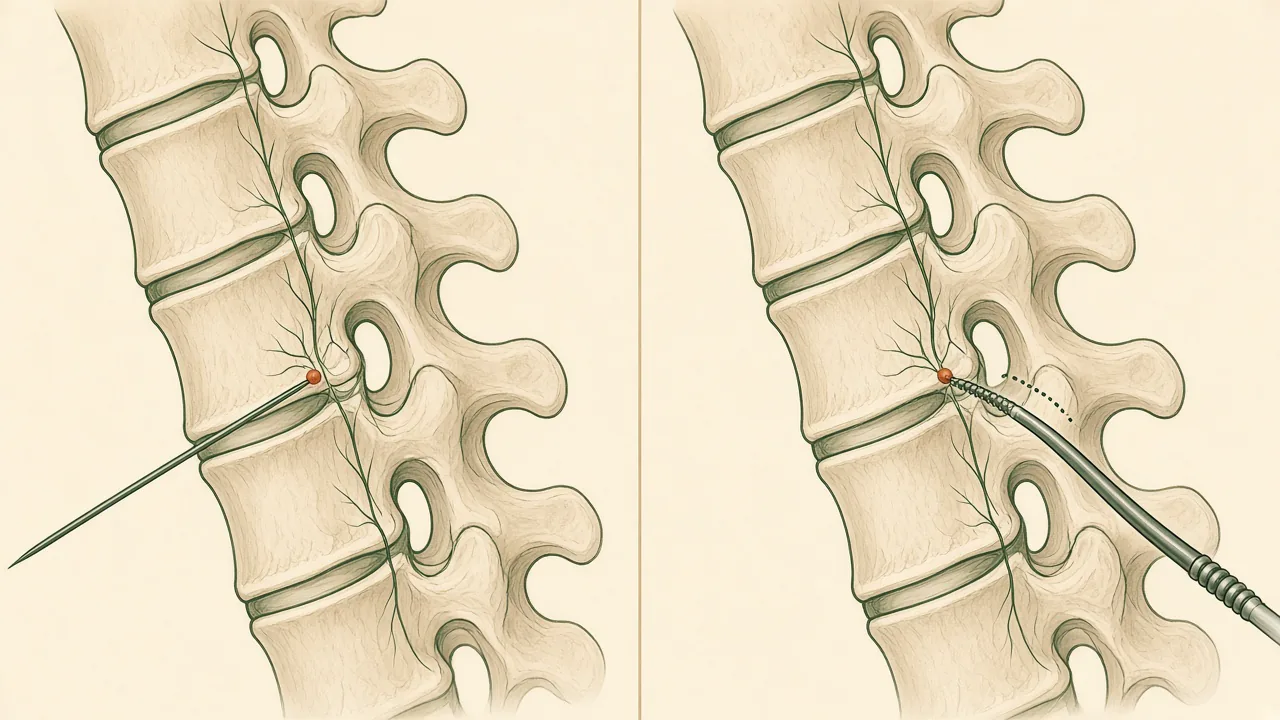
Radiofrequency energy is delivered through a carefully positioned probe near a selected neural target. Depending on the procedure, that target may carry sensation from a spinal facet joint, knee, hip, shoulder, chest wall, pelvic region, foot, or part of the head and face. The intended effect is target-specific pain-signal modulation, not repair of the underlying structure.
Major target-specific guides
Different RFA targets serve different purposes
The major pathways below involve different nerves, body regions, and clinical questions. Cervical and lumbar pages cover facet-focused procedures, while the genicular, hip articular branch, and suprascapular pages explain selected joint-related or peripheral targets. Open a target-specific guide for its anatomy, evidence, selection process, technique, risks, recovery, and alternatives.
Cervical Radiofrequency Ablation
Facet-focused RFA for selected medial branch targets in the neck.
Open this guideLumbar Radiofrequency Ablation
Facet-focused RFA for selected medial branch targets in the low back.
Open this guideGenicular Radiofrequency Ablation
RFA near selected sensory branches around the knee.
Open this guideHip Articular Branch Radiofrequency Ablation
RFA near selected sensory branches serving the hip capsule.
Open this guideSuprascapular Radiofrequency Ablation
Target-specific radiofrequency treatment involving a selected shoulder nerve pathway.
Open this guideFacet-specific selection
Facet RFA and medial branch blocks
Cervical and lumbar facet RFA target selected medial branch nerves that carry sensation from facet joints. In these two facet pathways, medial branch blocks are commonly used as a diagnostic or prognostic selection step. A response that matches the expected anesthetic window and meaningful activity may support the target hypothesis, but it does not prove the diagnosis or guarantee an RFA result. The number of blocks and response criteria vary across clinical guidance and coverage policies.
Learn how medial branch blocks inform facet RFA selection
Choose the guide that matches your question
Explore the specific guides.
Use these links to learn about related symptoms, conditions, and treatments. An individual evaluation is still needed to determine a diagnosis or whether a treatment may be appropriate.
Specific treatment
Cervical Radiofrequency Ablation
Cervical facet RFA anatomy, prerequisite evaluation, selection context, risks, and recovery.
Open this guideSpecific treatment
Lumbar Radiofrequency Ablation
Lumbar facet RFA anatomy, prerequisite evaluation, selection context, risks, and recovery.
Open this guideBeyond facet pathways
Peripheral and joint-branch RFA
Genicular, hip articular branch, and suprascapular RFA address different peripheral or joint-related neural targets. Other governed pathways include tibial, occipital, supraorbital, infraorbital, auriculotemporal, pudendal, and intercostal RFA. Each has its own anatomy, evidence, diagnostic questions, technical approach, and risk profile. A medial branch block is not a universal prerequisite for these non-facet procedures.
Match the question to the target
How target selection differs
A specific RFA discussion begins with the symptoms and the clinical problem being evaluated. Examination, target anatomy, imaging when relevant, diagnostic information, prior treatment, health and medication risks, functional goals, and target-specific evidence are considered together. A scan finding, a response to one test, or the availability of a procedure does not establish candidacy.
Symptoms and examination support a specific target hypothesis
Relevant imaging and diagnostic information are interpreted in context
Prior care, alternatives, health risks, and functional goals have been reviewed
The target-specific evidence and expected value justify considering the procedure
Technique and recovery vary
What to expect during and after RFA
After the target and purpose are confirmed, the clinician positions a radiofrequency probe using the imaging method appropriate for that anatomy. Exact positioning, sensory or motor testing, lesion location, energy technique, medication, and recovery instructions differ by target. Temporary soreness or altered sensation can occur. Neural function may recover over time, symptoms can return, and the timing and degree of any benefit cannot be predicted for an individual.
Confirm the diagnosis, clinical question, and exact neural target
Review target-specific technique, risks, evidence, and alternatives
Define meaningful pain and functional goals and an individualized recovery plan
Target-specific consent
Risks, limitations, and alternatives
General considerations include bleeding, infection, temporary pain, numbness or altered sensation, neuritis, incomplete benefit, no benefit, and injury to nearby structures. The likelihood and seriousness of specific risks depend on the target and technique. Alternatives may include continued diagnostic work, rehabilitation, medication, an injection or block, another intervention, or surgical evaluation when appropriate. The target-specific child page and individual consent discussion carry the details.
RFA does not repair arthritis, discs, stenosis, cartilage, or other structural disease.
No diagnostic response guarantees the magnitude or duration of benefit.
Target-specific risks and alternatives cannot be inferred from a different RFA procedure.
Common questions
Radiofrequency Ablation FAQ
These answers are educational and cannot determine an individual diagnosis or treatment plan.
Is all RFA the same procedure?
No. Different RFA procedures target different nerves and clinical problems, and their selection pathways, techniques, evidence, and risks are not interchangeable.
Do I always need a diagnostic block before RFA?
No. Diagnostic and prognostic pathways depend on the target. Cervical and lumbar facet RFA commonly use medial branch blocks, but that does not automatically apply to every RFA procedure.
Does RFA permanently destroy a nerve?
RFA changes signaling at a selected neural target. Neural function may recover or reinnervate depending on the procedure and target, so the effect should not be described as guaranteed or permanently complete.
How long does benefit last?
There is no guaranteed duration. Response varies by the neural target, diagnosis, selection process, technique, and patient. Some people may not benefit, and symptoms can return as neural function recovers or because other pain sources remain. A target-specific consultation provides more useful context than one general timeline.
Question before procedure
Start with the target, not the procedure name
A consultation can clarify the diagnosis, the neural target under consideration, and whether RFA or another next step fits the clinical picture.