
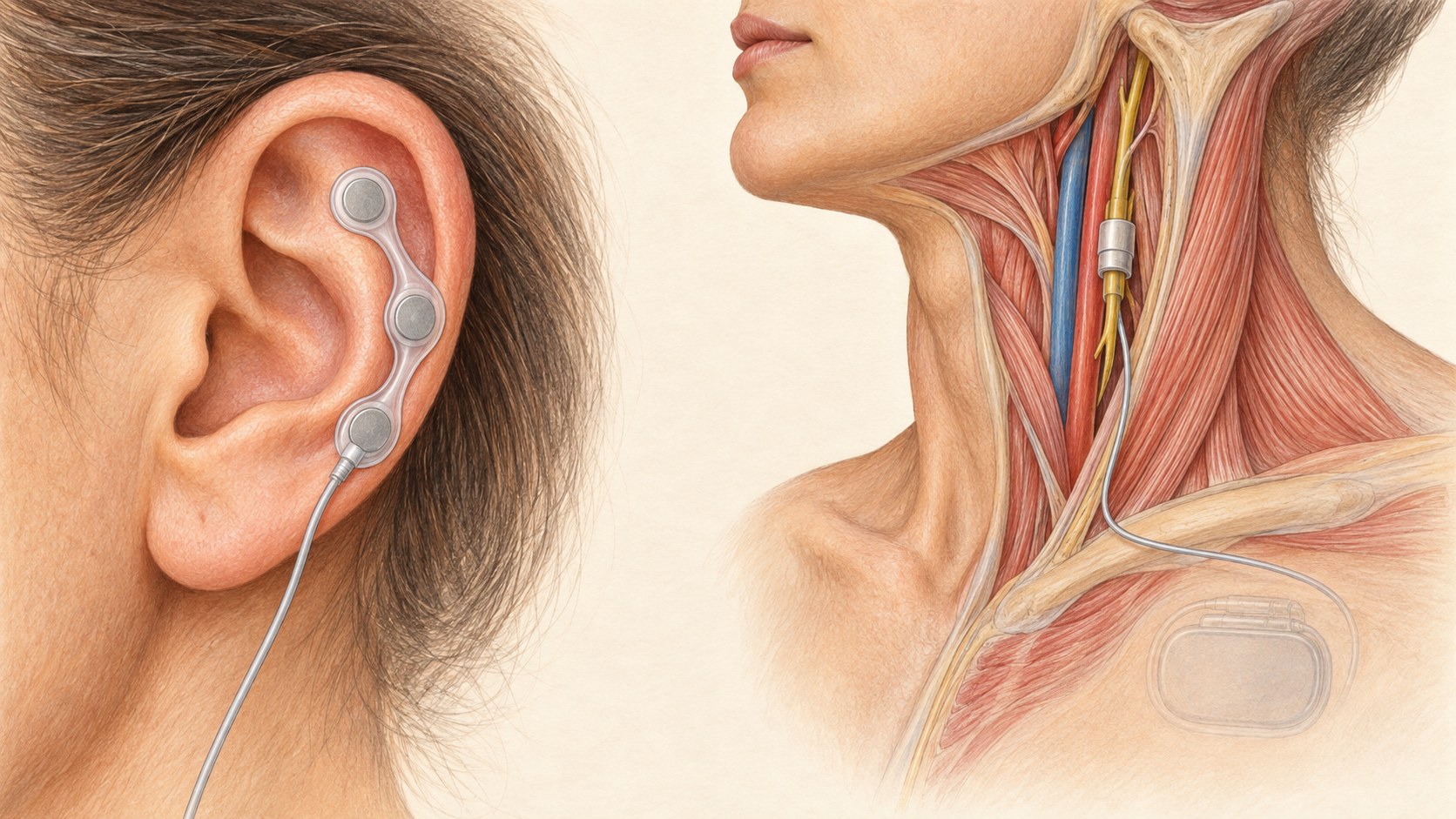
This page concerns temporary auricular stimulation, not a neck or chest implant.
Neuromodulation
Vagus / Auricular Neuromodulation
Auricular neuromodulation applies temporary stimulation at selected areas of the outer ear. It is not the same as an implanted cervical vagus nerve stimulator, and pain evidence remains emerging and protocol-specific.
Quick orientation
What to know first
Published pain studies use different devices, targets, schedules, and outcomes.
A practice protocol must be physician-confirmed before specific timing or device claims are published.
Learn what may come next
Related guides.
Use these links to learn about related symptoms, conditions, and treatments. An individual evaluation is still needed to determine a diagnosis or whether a treatment may be appropriate.
Care overview
Neuromodulation
Compare approved neuromodulation pathways and understand how modality selection differs by diagnosis, anatomy, and goals.
Open this guideSpecific treatment
Spinal Cord Stimulation
Understand spinal cord stimulation evaluation, trial, implantation, limitations, and selection context.
Open this guideSpecific treatment
Dorsal Root Ganglion (DRG) Stimulation
Understand DRG stimulation for selected focal neuropathic pain presentations, including trial and selection context.
Open this guideSpecific treatment
Peripheral Nerve Stimulation
Understand peripheral nerve stimulation for selected named peripheral-nerve pain presentations.
Open this guideTarget and mechanism
The target defines the modality
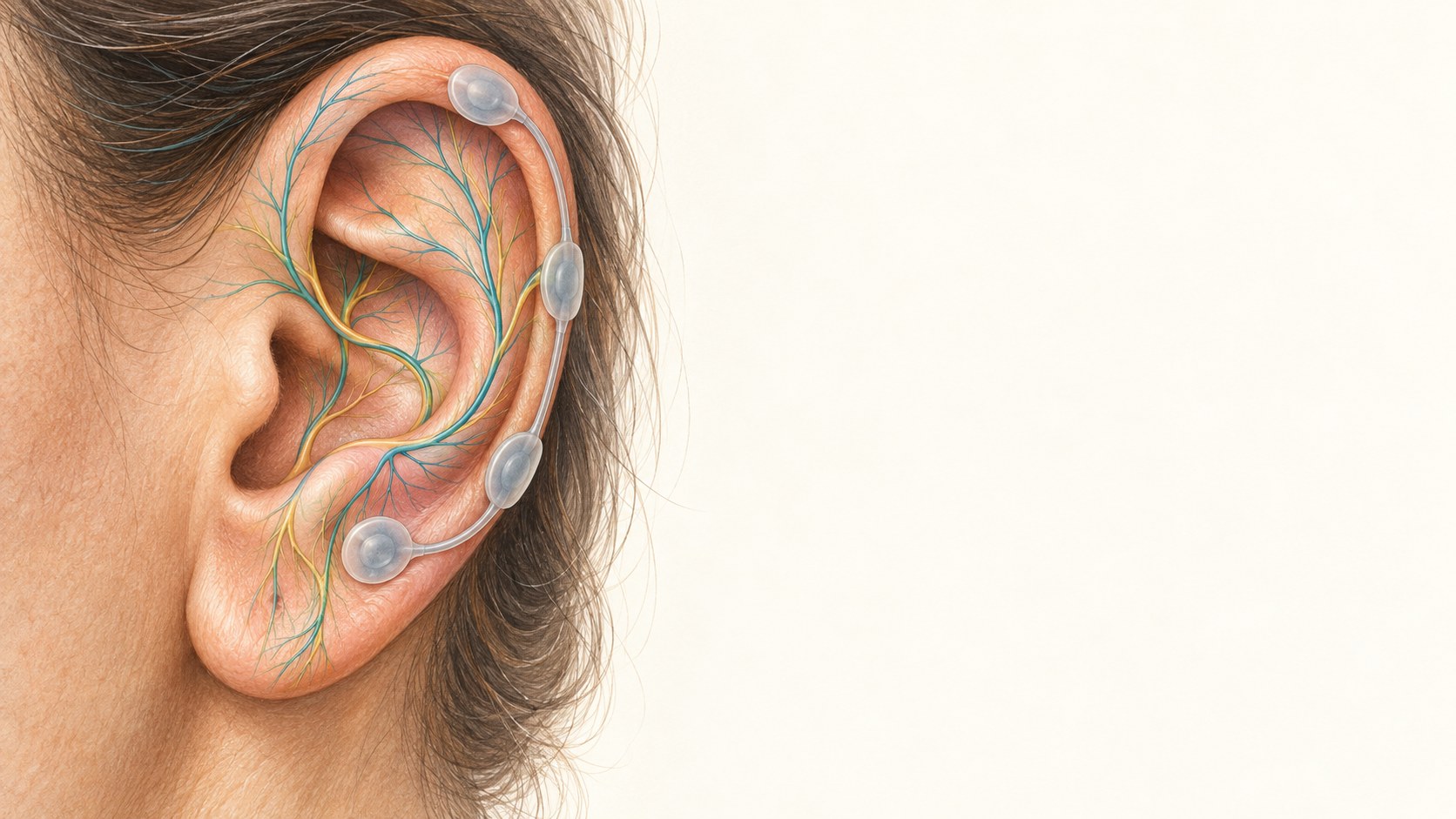
The outer ear receives sensory input from several nerves, including an auricular branch associated with the vagus nerve. External or percutaneous devices stimulate selected ear regions. That anatomy does not make every ear protocol equivalent or prove a vagal mechanism.
Patient selection
Selection questions
These questions help determine whether the proposed neural target and treatment plan fit the individual problem.
A clearly defined pain condition and treatment goal
Review of standard care and why an adjunctive option is being considered
Ability to protect the treatment site and report skin or neurologic symptoms
Understanding that evidence is emerging and not interchangeable with implanted VNS evidence
A staged decision
How we decide what may come next
A temporary device or small electrode array is positioned on selected auricular sites for a defined course. Exact targets, duration, maintenance, and follow-up vary by protocol and must be confirmed by the treating clinician.
Related care
Conditions this treatment may be considered for
These related guides show educational connections. They do not establish candidacy, a recommendation, or a required sequence.
Alternative
Painful Diabetic Neuropathy
Practice-specific alternative only for selected patients under the actual temporary protocol; not implanted cervical VNS.
Explore this pageDecision process
Decision sequence
The safest sequence starts with diagnosis and target, then compares alternatives and evidence, and only then considers a trial, temporary treatment, or implant.
Clarify the device and whether it is external or percutaneous
Review the evidence for the specific pain condition
Confirm treatment-site care, stop rules, and follow-up
Evidence at a glance
Evidence at a glance
Evidence must be matched to the exact diagnosis, comparator, follow-up period, and system studied.
A 2025 observational cohort reported improvement after a defined auricular protocol, but it was not randomized and was conducted in a specific population.
Systematic reviews find possible pain benefit with substantial heterogeneity and risk-of-bias concerns.
No claim from implanted cervical VNS should be transferred to this auricular pathway.
Decision quality matters
Evidence, limits, and who it may fit
Relationship membership does not establish candidacy. Published results must be qualified by selection criteria, study design, durability, complications, and alternatives.
Risks and limits
Evidence, risks, and limits
A 2025 observational cohort reported improvement after a defined auricular protocol, but it was not randomized and was conducted in a specific population. Systematic reviews find possible pain benefit with substantial heterogeneity and risk-of-bias concerns. No claim from implanted cervical VNS should be transferred to this auricular pathway.
Skin irritation, discomfort, bleeding, infection, dizziness, or vasovagal symptoms may occur depending on the method.
Optimal target, schedule, duration, and maintenance are not established across pain conditions.
Observational improvement does not prove comparative effectiveness.
The visit
What to expect from an evaluation
The visit should identify the diagnosis, the proposed neural target, the evidence that applies to that exact condition, alternatives, and a measurable next step.
Common questions
Vagus / Auricular Neuromodulation FAQ
These answers are educational and cannot determine an individual diagnosis or treatment plan.
Is this an implanted vagus nerve stimulator?
No. This page concerns temporary stimulation at the outer ear and does not describe an implanted cervical lead or chest generator.
How long is treatment?
Protocols vary. The exact schedule must come from the clinician and device-specific plan rather than being inferred from one study.
Is auricular neuromodulation proven for chronic pain?
Evidence is promising in some studies but heterogeneous and often limited by study design, protocol variation, and risk of bias.
Target before technology
Start with a target-specific consultation
A consultation can clarify whether this modality, another treatment, or continued diagnostic work is the appropriate next step.