
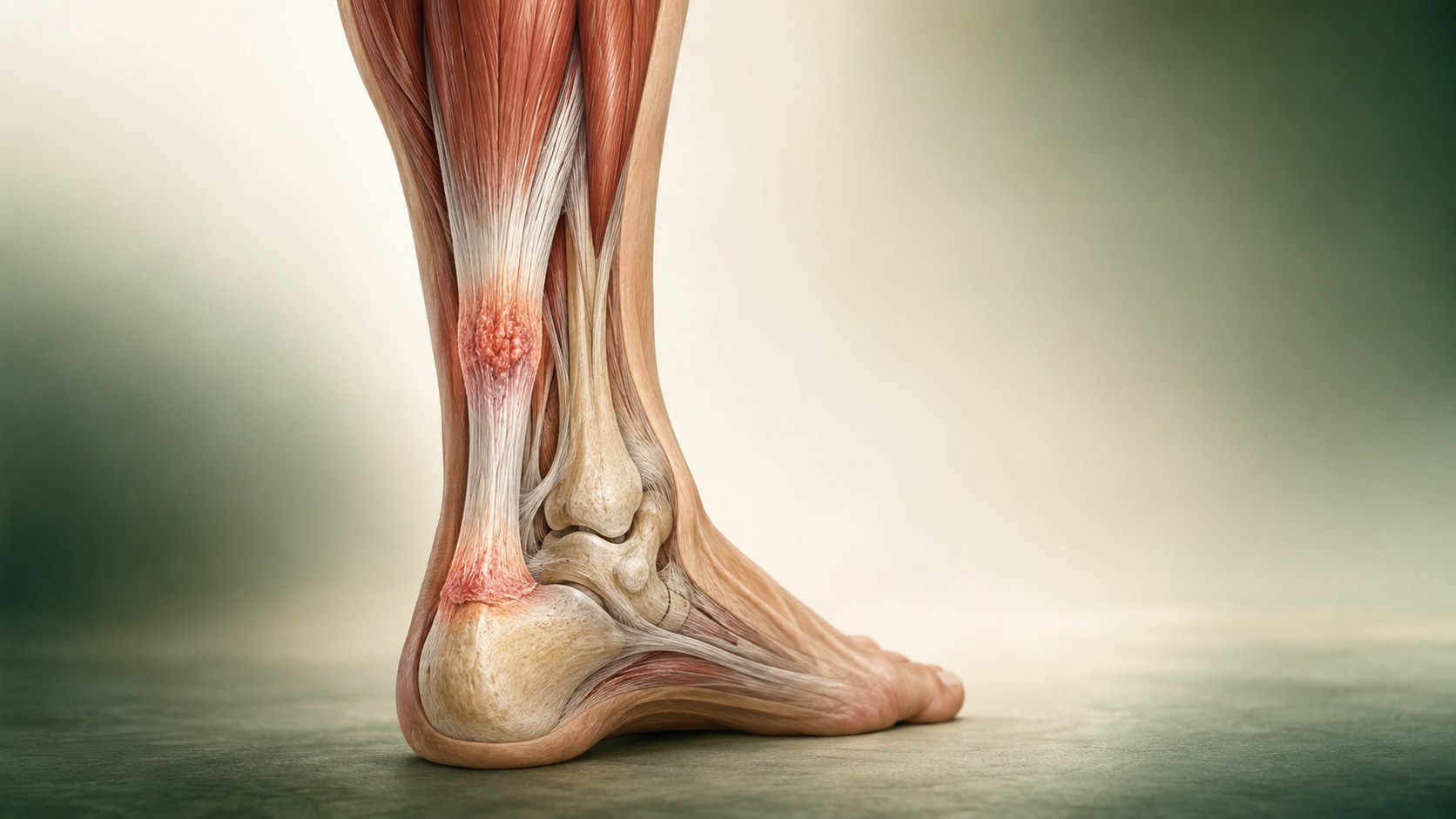
Midportion symptoms occur above the heel; insertional symptoms sit where the tendon meets the heel bone.
Leg, Ankle & Foot
Achilles Tendinopathy
Achilles tendinopathy usually causes load-related pain and stiffness at the back of the ankle. The exact location matters because midportion and insertional problems are not managed identically.
Quick orientation
What to know first
Morning stiffness and pain with running, jumping, or repeated heel raises are common clues.
Progressive tendon loading is central. PRP has not shown consistent benefit over placebo.
What we may consider next
How we may treat this
These options depend on the diagnosis, exam findings, prior care, goals, and individual risk review. A listed pathway does not establish candidacy or guarantee a later procedure.
Options that may be considered
These are options, not required steps. Selection depends on the diagnosis and individual review.
Treatment option
Platelet-Rich Plasma (PRP)
PRP may be discussed only after diagnosis-specific evidence, alternatives, and individual patient factors are reviewed.
Symptoms are clues, not a diagnosis
What the pattern can feel like
Symptoms help define the pattern and show which daily, work, or athletic demands are difficult. They also guide the physical examination. No single symptom, tender spot, or self-test confirms the diagnosis, so a clinician still needs to consider nearby joints, nerves, referred pain, and other tissue problems.
Morning or start-up stiffness
Pain during or after running, jumping, or prolonged walking
Tenderness or thickening at the midportion or heel insertion
Relevant anatomy
Anatomy and pain source
The Achilles tendon joins the calf muscles to the calcaneus. Midportion tendinopathy affects the tendon above the heel. Insertional tendinopathy affects the attachment at the heel bone and may be sensitive to compression in deeper ankle dorsiflexion.
History and examination first
How the diagnosis is evaluated
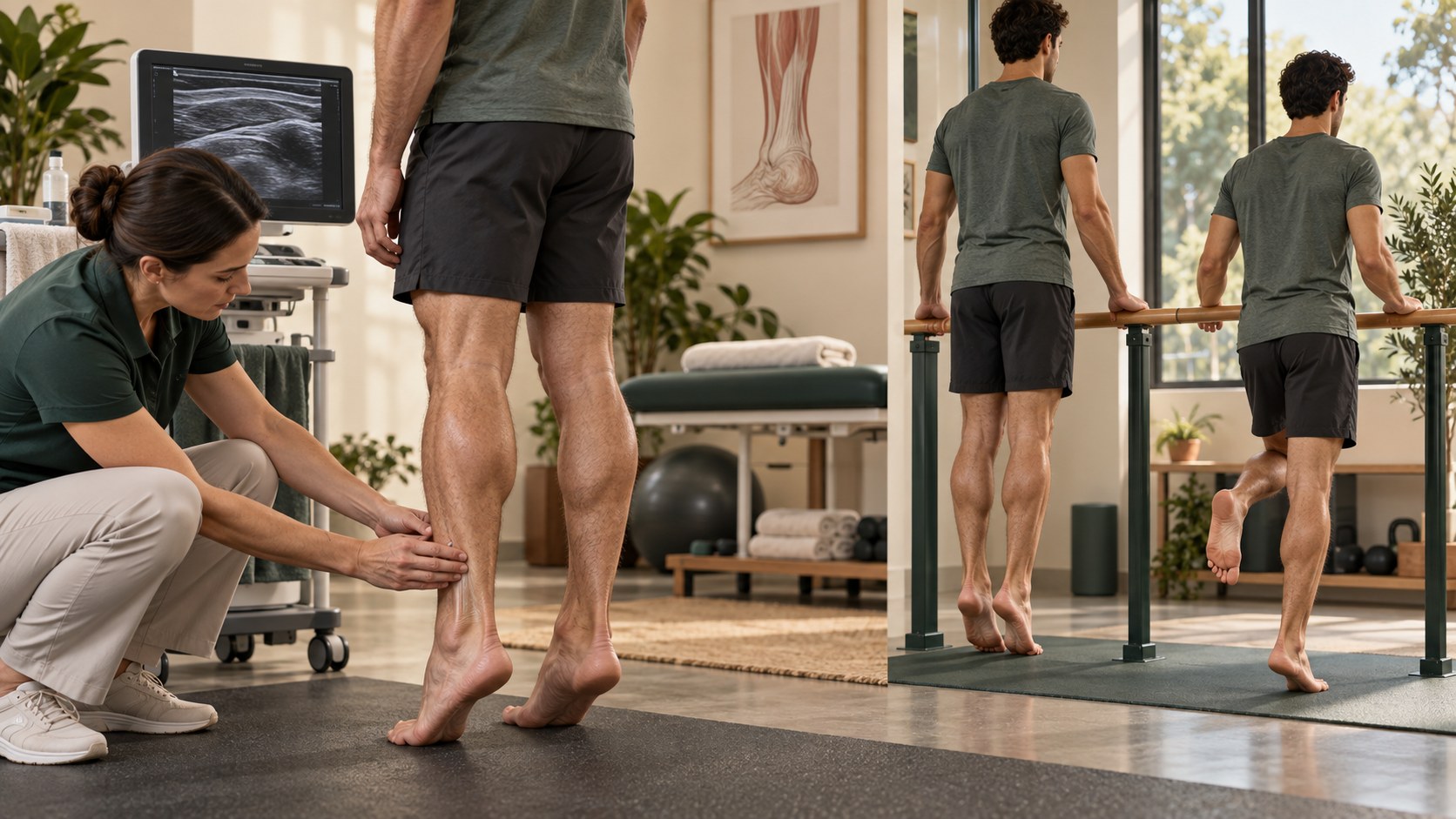
The examination maps the painful region, observes walking and heel-rise capacity, checks tendon continuity, and reviews training or workload changes. Ultrasound or MRI can help when rupture, another diagnosis, or treatment planning is in question.
Keep the differential open
What else can look similar
A diagnosis is safer when the common alternatives are considered instead of treating pain location as proof.
- Partial or complete Achilles rupture
- Retrocalcaneal bursitis or insertional bone prominence
- Calf or posterior ankle pain from another structure
- Inflammatory disease or medication-related tendon risk
Core care
Conservative care remains the foundation
Care should build capacity and reduce unnecessary protection while staying responsive to the exact diagnosis and symptom behavior.
Modify the provoking load without prolonged complete rest
Use progressive calf and Achilles loading matched to symptom location
Address footwear, training errors, strength, and mobility when relevant
Allow enough time for graded adaptation and reassessment
Evidence at a glance
Evidence at a glance
The evidence is not a scoreboard. Comparator choice, follow-up, patient selection, and the exact tissue problem can change the result.
The 2024 clinical guideline supports tendon-loading exercise as first-line care for midportion Achilles tendinopathy.
Improvement often takes sustained rehabilitation rather than a quick passive treatment.
A large placebo-controlled trial found that PRP did not improve chronic midportion Achilles tendon dysfunction compared with sham injection.
Decision quality matters
Evidence, limits, and who it may fit
Procedure consideration requires a confirmed diagnosis, correlation between symptoms and anatomy, review of prior care, contraindications, alternatives, goals, and the limits of the diagnosis-specific evidence. Relationship membership does not establish candidacy.
- The 2024 clinical guideline supports tendon-loading exercise as first-line care for midportion Achilles tendinopathy.
- Improvement often takes sustained rehabilitation rather than a quick passive treatment.
- A large placebo-controlled trial found that PRP did not improve chronic midportion Achilles tendon dysfunction compared with sham injection.
Referral and urgent signs
When another or urgent evaluation matters
Some findings should redirect the plan toward urgent care, another specialist, or a different diagnosis.
- A sudden snap or pop with immediate weakness
- Inability to push off or perform a heel raise after an acute event
- Marked swelling, bruising, fever, or rapidly worsening symptoms
The visit
What to expect at an evaluation
The visit should narrow the diagnosis, clarify what has already been tried, and identify the next useful decision rather than defaulting to an injection. That may mean refining a rehabilitation plan, obtaining imaging only when it would change care, discussing a procedure with its evidence limits, or arranging another specialist evaluation.
Identify whether symptoms are midportion, insertional, or something else
Check tendon continuity and functional load tolerance
Build or refine a progressive loading plan and decide whether imaging is needed
Common questions
Achilles Tendinopathy FAQ
These answers are educational and cannot determine an individual diagnosis or treatment plan.
Should I stop all activity?
Usually not. Load often needs to be reduced and rebuilt, but prolonged complete rest can reduce capacity. The plan should match symptom severity and tendon location.
What is the difference between insertional and midportion pain?
Insertional pain is at the heel attachment. Midportion pain is higher in the tendon. That difference can change exercise position and treatment planning.
Does PRP heal the Achilles tendon?
PRP should not be described as healing or rebuilding the tendon. High-quality placebo-controlled evidence has not shown a reliable added benefit for chronic midportion Achilles tendinopathy.
Diagnosis before procedure
Start with a careful evaluation
The next step is to confirm the pain source, review prior care, and choose a plan that fits the diagnosis and your goals.