
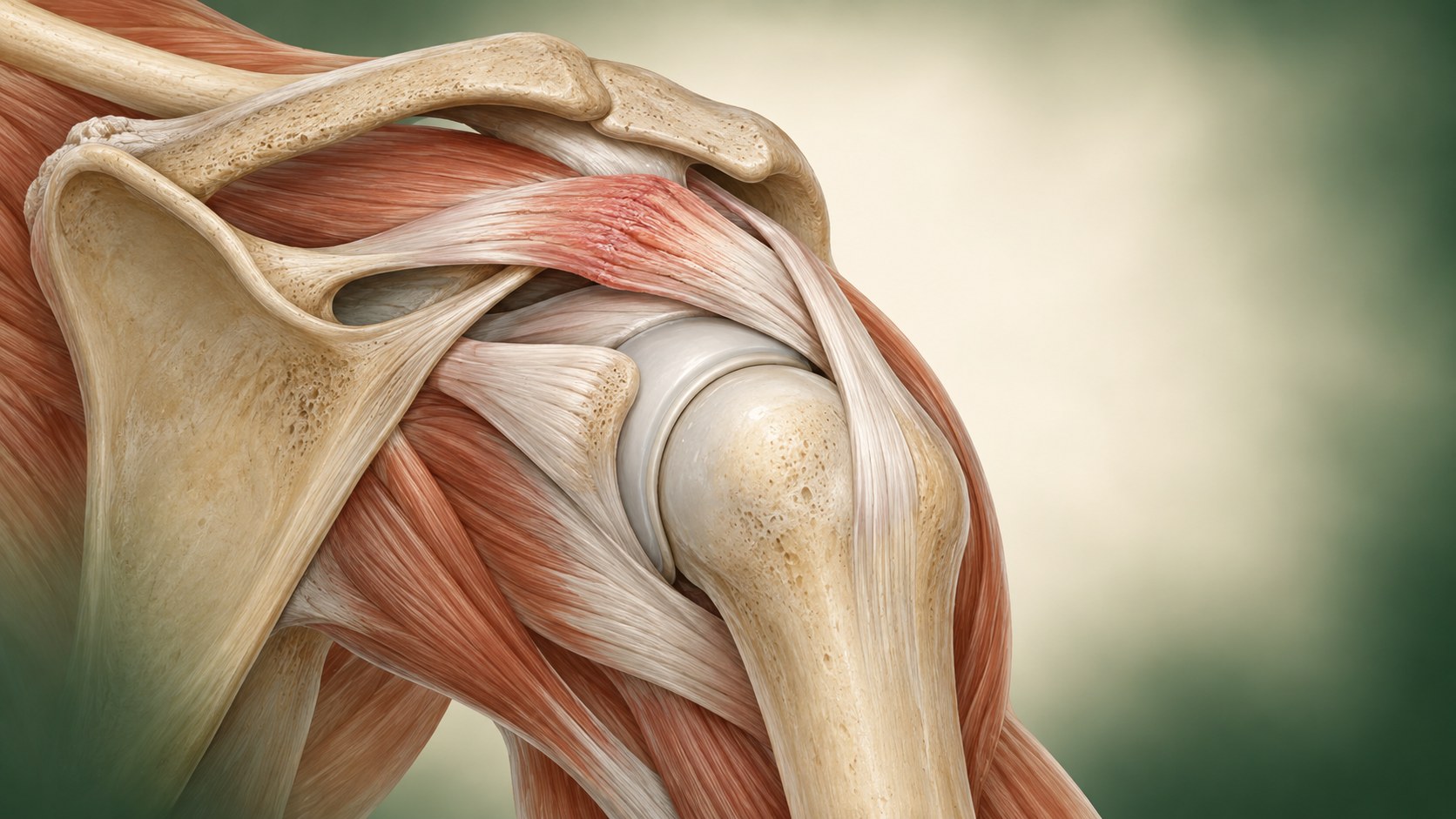
The rotator cuff centers and moves the shoulder through four connected muscles and tendons.
Shoulder, Elbow & Arm
Rotator Cuff Tendinopathy
Rotator cuff tendinopathy can make reaching, lifting, and lying on the shoulder painful. Similar symptoms can come from a tear, arthritis, the neck, or other shoulder structures, so the page starts with diagnosis rather than a procedure.
Quick orientation
What to know first
Painful motion does not reveal whether the tendon is intact, partially torn, or not the main pain source.
Exercise-based rehabilitation is central. Routine PRP use is not supported by the current AAOS guideline.
What we may consider next
How we may treat this
These options depend on the diagnosis, exam findings, prior care, goals, and individual risk review. A listed pathway does not establish candidacy or guarantee a later procedure.
Options that may be considered
These are options, not required steps. Selection depends on the diagnosis and individual review.
Treatment option
Platelet-Rich Plasma (PRP)
PRP may be discussed only after diagnosis-specific evidence, alternatives, and individual patient factors are reviewed.
Symptoms are clues, not a diagnosis
What the pattern can feel like
Symptoms help define the pattern and show which daily, work, or athletic demands are difficult. They also guide the physical examination. No single symptom, tender spot, or self-test confirms the diagnosis, so a clinician still needs to consider nearby joints, nerves, referred pain, and other tissue problems.
Pain with overhead reach or lifting away from the body
Night pain, especially when lying on the involved side
Painful weakness or reduced endurance
Relevant anatomy
Anatomy and pain source
The rotator cuff tendons wrap around the humeral head and work with the shoulder blade to guide movement. Tendinopathy describes tendon pain and impaired load tolerance. It is not the same as a full-thickness tear, although the two can coexist.
History and examination first
How the diagnosis is evaluated
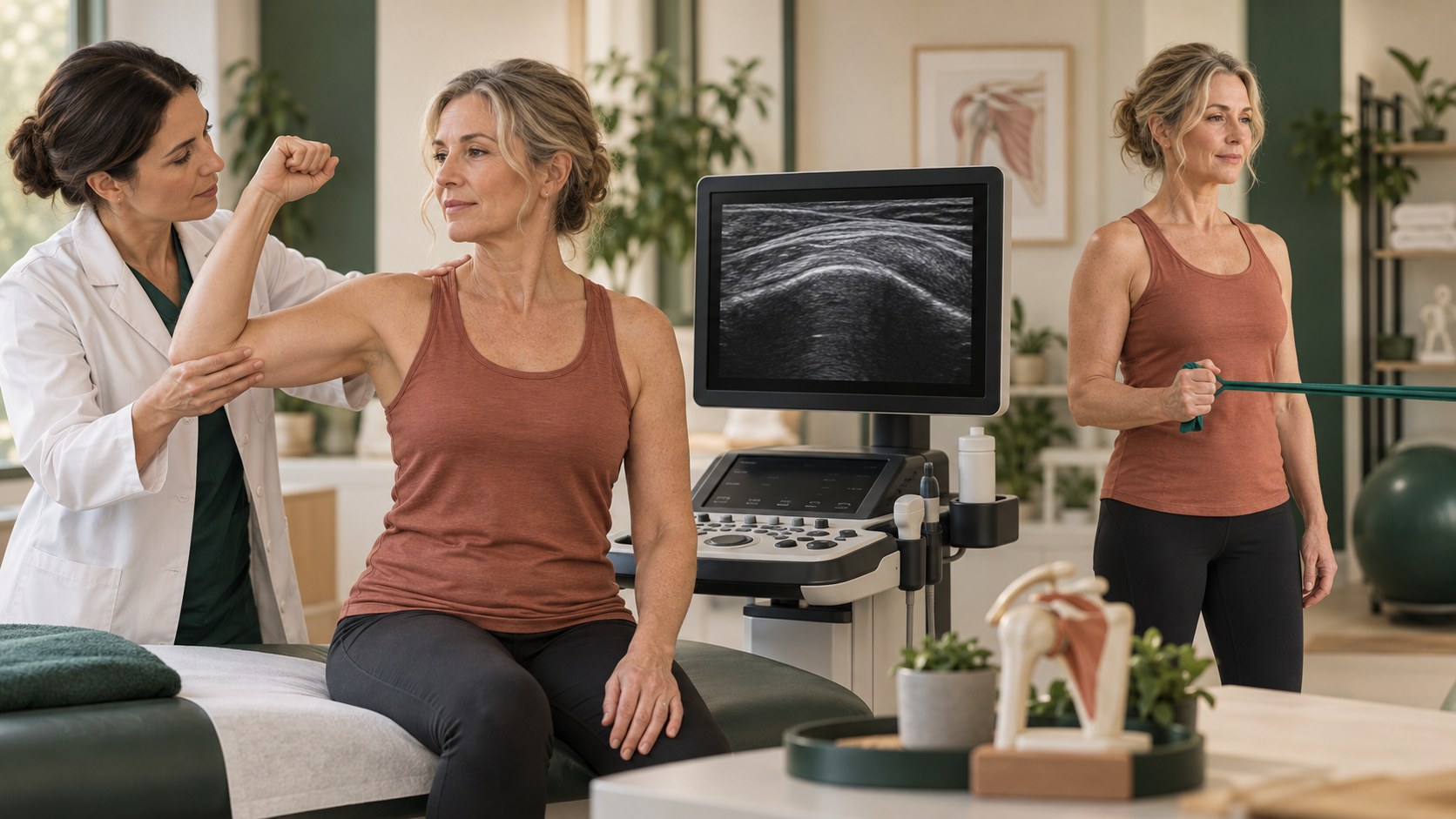
A focused examination checks active and passive motion, strength, symptom behavior, the neck, and functional goals. Ultrasound or MRI is most useful when a tear is suspected, weakness is substantial, symptoms persist, or imaging would change referral or treatment planning.
Keep the differential open
What else can look similar
A diagnosis is safer when the common alternatives are considered instead of treating pain location as proof.
- Full-thickness or significant partial-thickness rotator cuff tear
- Shoulder osteoarthritis or adhesive capsulitis
- Biceps, acromioclavicular, or other periarticular pain
- Pain referred from the cervical spine or a nerve
Core care
Conservative care remains the foundation
Care should build capacity and reduce unnecessary protection while staying responsive to the exact diagnosis and symptom behavior.
Modify provocative loads while preserving comfortable motion
Progress rotator cuff and shoulder-blade strengthening
Address mobility, sleep positions, and work or sport demands
Reconsider the diagnosis when weakness or stiffness does not fit tendinopathy
Evidence at a glance
Evidence at a glance
The evidence is not a scoreboard. Comparator choice, follow-up, patient selection, and the exact tissue problem can change the result.
Exercise and rehabilitation remain foundational for nontraumatic rotator cuff pain.
The 2025 AAOS guideline does not support routine PRP for rotator cuff tendinopathy or partial tears because results are inconsistent and heterogeneous.
Some reviews report modest later benefits versus corticosteroid, but this does not establish superiority over a complete rehabilitation program or apply to full-thickness tears.
Decision quality matters
Evidence, limits, and who it may fit
Procedure consideration requires a confirmed diagnosis, correlation between symptoms and anatomy, review of prior care, contraindications, alternatives, goals, and the limits of the diagnosis-specific evidence. Relationship membership does not establish candidacy.
- Exercise and rehabilitation remain foundational for nontraumatic rotator cuff pain.
- The 2025 AAOS guideline does not support routine PRP for rotator cuff tendinopathy or partial tears because results are inconsistent and heterogeneous.
- Some reviews report modest later benefits versus corticosteroid, but this does not establish superiority over a complete rehabilitation program or apply to full-thickness tears.
Referral and urgent signs
When another or urgent evaluation matters
Some findings should redirect the plan toward urgent care, another specialist, or a different diagnosis.
- Sudden loss of strength after an injury
- A new deformity, dislocation, or inability to raise the arm
- Fever, a hot swollen joint, or progressive neurologic weakness
The visit
What to expect at an evaluation
The visit should narrow the diagnosis, clarify what has already been tried, and identify the next useful decision rather than defaulting to an injection. That may mean refining a rehabilitation plan, obtaining imaging only when it would change care, discussing a procedure with its evidence limits, or arranging another specialist evaluation.
Separate motion loss, painful weakness, and true strength loss
Screen the neck and neighboring shoulder structures
Decide whether rehabilitation, imaging, or orthopedic referral is the appropriate next step
Common questions
Rotator Cuff Tendinopathy FAQ
These answers are educational and cannot determine an individual diagnosis or treatment plan.
Does shoulder pain mean I have a torn rotator cuff?
No. Tendon pain, stiffness, arthritis, referred neck pain, and tears can overlap. A clinician compares active and passive motion, strength, symptom behavior, and the injury history. Selective imaging can then answer a focused question when the result would change rehabilitation, referral, or another treatment decision.
Do I need an MRI before therapy?
Not always. Many nontraumatic presentations can begin with a clinical evaluation and rehabilitation. Imaging becomes more useful when weakness, trauma, failed care, or referral planning changes the question.
Where does PRP fit?
PRP may be discussed for selected persistent tendon problems, but evidence is inconsistent and routine use is not supported by the current AAOS guideline.
Diagnosis before procedure
Start with a careful evaluation
The next step is to confirm the pain source, review prior care, and choose a plan that fits the diagnosis and your goals.