
Key Takeaways
- PRP is a platelet-concentrated blood product; it is not stem-cell or exosome therapy.
- Research results differ across trials, partly because PRP preparations, comparison treatments, and patient groups vary.
- A reasonable conversation starts with the diagnosis, osteoarthritis severity, prior care, goals, cost, and the uncertainty around who is most likely to benefit.
- PRP should not be described as regrowing cartilage or preventing knee replacement; those outcomes are not established.
- A study can show an earlier average symptom difference without proving durable benefit, cartilage regrowth, or an individual patient's response.
- Credible evidence includes both favorable signals and neutral findings; the useful question is what each study actually tested.
Start with the knee, not the injection
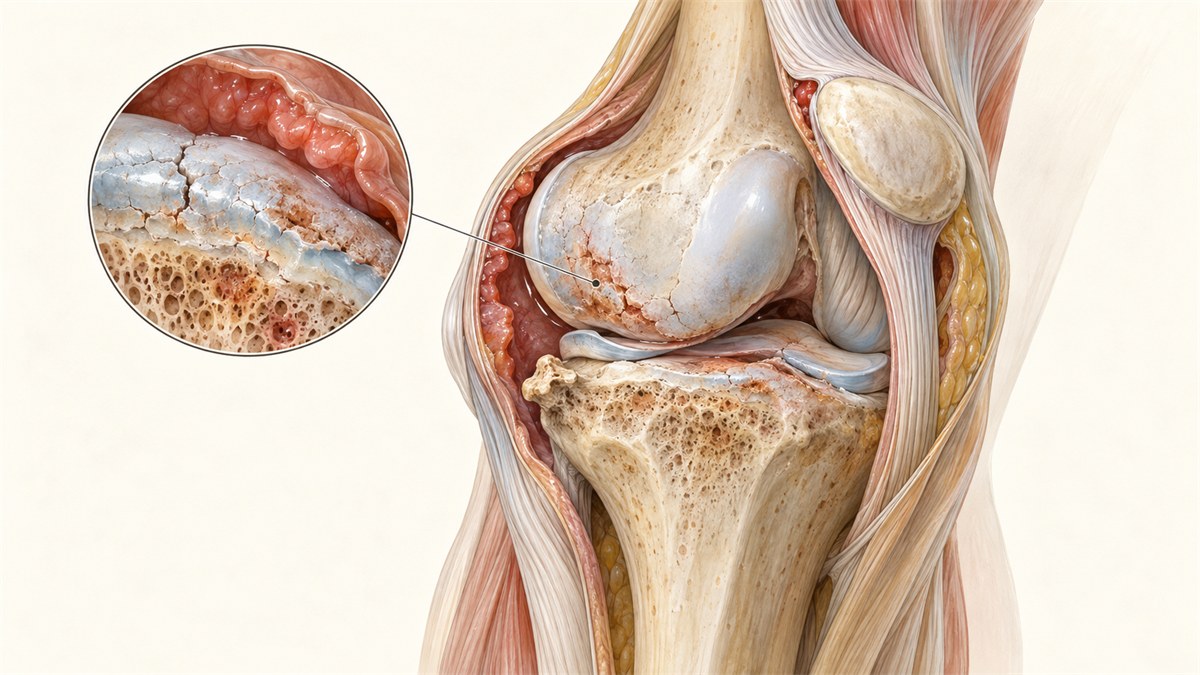
Knee osteoarthritis is not one uniform experience. Pain may be influenced by joint structure, inflammation, strength, activity demands, sleep, weight-bearing tolerance, and other diagnoses around the hip, back, or knee. An injection decision makes more sense after the symptom pattern, examination, and available imaging are considered together.
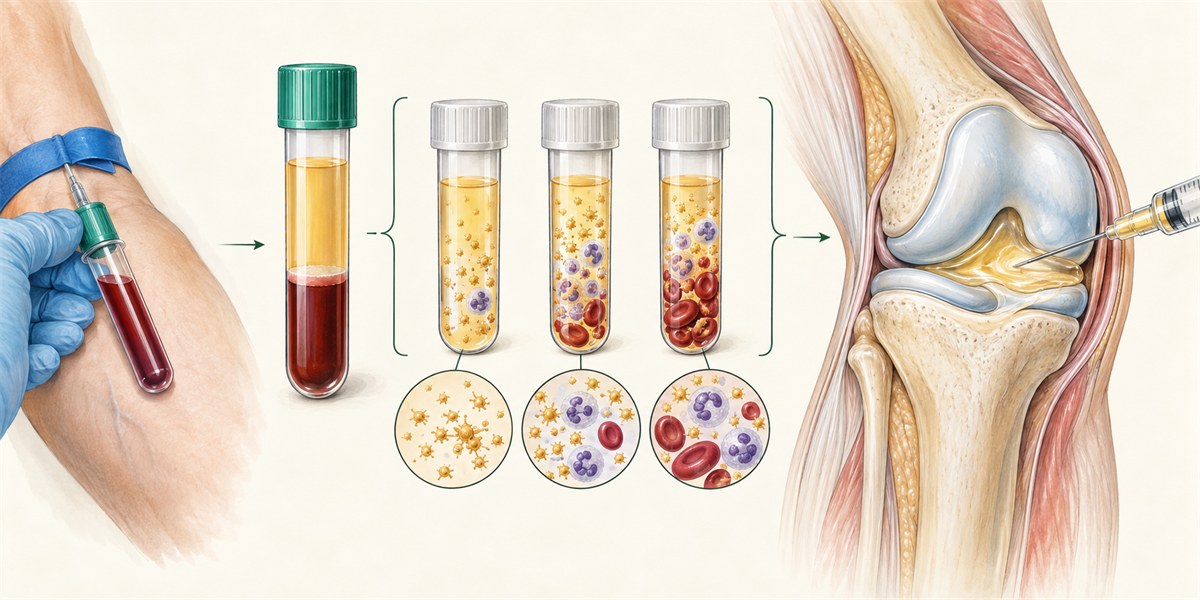
PRP is prepared by drawing blood and concentrating platelets in plasma before injection. The details matter: preparation systems can produce products with different platelet and white-cell characteristics. That variability is one reason a result from one trial cannot automatically be applied to every PRP protocol.
PRP is a category, not one uniform injection
Studies may also use different numbers of injections, spacing, handling methods, and post-procedure plans. Calling every protocol simply “PRP” can hide differences that matter when results are compared.
The 2024 ESSKA-ORBIT consensus devoted separate questions to rationale, indications, preparation and characterization, and protocol. That structure is a useful reminder: a headline about PRP does not tell you enough to know whether the tested intervention resembles a particular clinical protocol.
Begin with five questions, not a verdict
It is tempting to sort a study into one of two piles: PRP works or PRP does not work. Knee osteoarthritis research rarely fits that cleanly. A more useful reading starts with five questions: Who was studied? What was prepared and injected? What was the comparison? Which outcome was measured? How long were participants followed?
Those details can change the meaning of a result. A trial in a selected group with mild-to-moderate osteoarthritis may not answer the same question as a study with a broader population. A pain score at three months is also a different outcome from function at six months or cartilage volume at one year.
What the evidence actually says
Systematic reviews and expert consensus documents report symptom improvement in many studies, particularly among people with mild-to-moderate knee osteoarthritis. That is an encouraging signal, not a promise for an individual patient. Many comparisons involve hyaluronic acid or corticosteroid injections, and study methods are heterogeneous.
A rigorous placebo-controlled trial offers an important counterweight. In the RESTORE trial, three PRP injections did not produce a statistically significant advantage over saline placebo for the study’s primary pain outcome at 12 months, and did not reduce medial tibial cartilage-volume loss. A balanced discussion should hold both bodies of evidence at once rather than selecting only favorable studies.
Why a neutral trial and a favorable synthesis can both matter
The RESTORE randomized trial studied three weekly leukocyte-poor PRP injections in 288 adults with symptomatic mild-to-moderate medial knee osteoarthritis.
A 2025 meta-analysis pooled 11 placebo-controlled trials involving 1,616 participants. Average pain measures favored PRP at three and six months, but the results were highly heterogeneous, and the analysis did not show efficacy at 12 months. The authors described the average effect as weak and its clinical relevance as debatable.
These findings are not interchangeable. RESTORE gives a detailed answer about one rigorously tested regimen and population. A meta-analysis asks what appears across multiple trials, but pooling cannot erase their differences. The disagreement is informative: preparation, selection, outcome choice, and time horizon deserve attention.
Guidelines show the uncertainty in plain sight
The American Academy of Orthopaedic Surgeons states that PRP may reduce pain and improve function in symptomatic knee osteoarthritis, but labels the recommendation limited. That wording is neither a guarantee nor a declaration that the treatment never helps.
The ESSKA-ORBIT consensus is more favorable for selected patients with mild-to-moderate knee osteoarthritis. It also reports that only nine of its 28 statements had high-level scientific support, while the remaining statements rested on medium-to-low-quality evidence. Consensus can guide decisions, but expert agreement should not be mistaken for certainty in every unanswered area.
What PRP may and may not be trying to do
For a patient considering PRP, the practical goal is usually a meaningful improvement in pain and function that supports walking, exercise, work, or rehabilitation. The treatment should not be framed as a cure, as guaranteed tissue regeneration, or as proof that other parts of a care plan are no longer needed.
The time course, number of injections, medication instructions, and rehabilitation plan may differ by clinician and protocol. Patients should receive procedure-specific instructions from the treating practice rather than change medicines or activity based on a general article.
What this evidence cannot decide for one person
Population averages do not identify an individual's diagnosis, pain source, goals, safety considerations, or likelihood of responding. The evidence also does not justify describing PRP as a cartilage-regrowth treatment.
- Ask which PRP preparation and injection schedule are used.
- Ask which patient group and comparator best match the evidence being discussed.
- Ask whether the expected goal is pain, function, or another measurable outcome.
- Ask when the result will be assessed and what would count as meaningful improvement.
Questions worth asking before deciding
A useful consultation is specific. Ask what diagnosis is being treated; why PRP is being considered now; what alternatives remain reasonable; which preparation is used; how outcomes will be measured; what out-of-pocket cost is expected; and what would count as an unsuccessful trial. Also ask how the injection fits with exercise, strength, weight management when relevant, medications, and surgical consultation when appropriate.
Candidacy and safety depend on the person, procedure, medications, and health history. Infection risk, bleeding considerations, post-injection symptoms, and medication management require individualized instructions. This development article intentionally does not supply a universal contraindication list.
Evidence context
Evidence is moving, and different professional groups have interpreted it differently. The most honest conclusion is narrower than either enthusiasm or dismissal: PRP may be considered for some patients with symptomatic knee osteoarthritis after diagnosis-first evaluation and informed discussion, while meaningful uncertainty remains about protocol, selection, durability, structural effects, and comparative value.
References
- The use of injectable orthobiologics for knee osteoarthritis: a European ESSKA-ORBIT consensus. Part 1: blood-derived products. Knee Surgery, Sports Traumatology, Arthroscopy, 2024.
- Effect of Intra-articular Platelet-Rich Plasma vs Placebo Injection on Pain and Medial Tibial Cartilage Volume in Patients With Knee Osteoarthritis. JAMA, 2021-11-23.
- Efficacy of intra-articular platelet-rich plasma compared with placebo in knee osteoarthritis: A systematic review and meta-analysis. Joint Bone Spine, 2025.
- Management of Osteoarthritis of the Knee (Non-Arthroplasty), Third Edition. American Academy of Orthopaedic Surgeons, 2021.