
GTPS describes a clinical syndrome, not one damaged structure.
Hip & Thigh · Lateral Hip Pain
Greater Trochanteric Pain Syndrome
Greater trochanteric pain syndrome, or GTPS, is a broad name for pain around the outside of the hip. Gluteal tendinopathy is one possible driver within the syndrome, not a synonym for every case.
Quick orientation
What to know first
Gluteal tendons are common pain sources; the nearby bursa may also be involved.
Exercise and education are first-line. An injection target must match the evaluated pain generator.
What we may consider next
How we may treat this
These options depend on the diagnosis, exam findings, prior care, goals, and individual risk review. A listed pathway does not establish candidacy or guarantee a later procedure.
Options that may be considered
These are options, not required steps. Selection depends on the diagnosis and individual review.
Treatment option
Trochanteric Bursa / Periarticular Injection
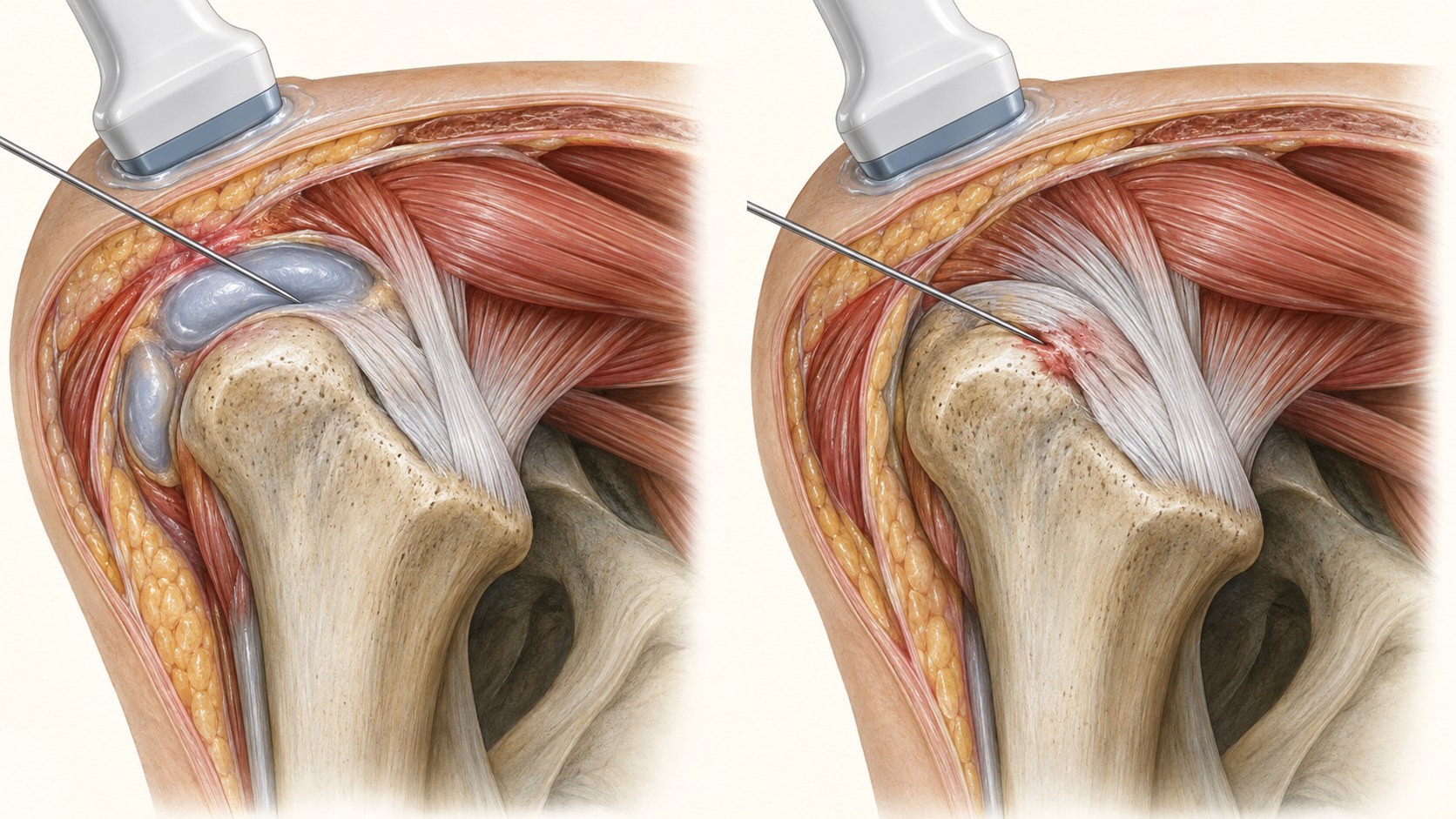
May be considered when the selected lateral-hip target and pathology support an injection; it does not treat every GTPS mechanism.
Treatment option
Platelet-Rich Plasma (PRP)
PRP may be discussed only when evaluation identifies an appropriate tendon target; GTPS is the syndrome and gluteal tendinopathy is a possible underlying cause.
Symptoms are clues, not a diagnosis
What the pattern can feel like
Symptoms help define the pattern and show which daily, work, or athletic demands are difficult. They also guide the physical examination. No single symptom, tender spot, or self-test confirms the diagnosis, so a clinician still needs to consider nearby joints, nerves, referred pain, and other tissue problems.
Pain over the outside of the hip
Pain when lying on that side, climbing stairs, or standing on one leg
Reduced tolerance for walking, hills, or prolonged standing
Relevant anatomy
Anatomy and pain source
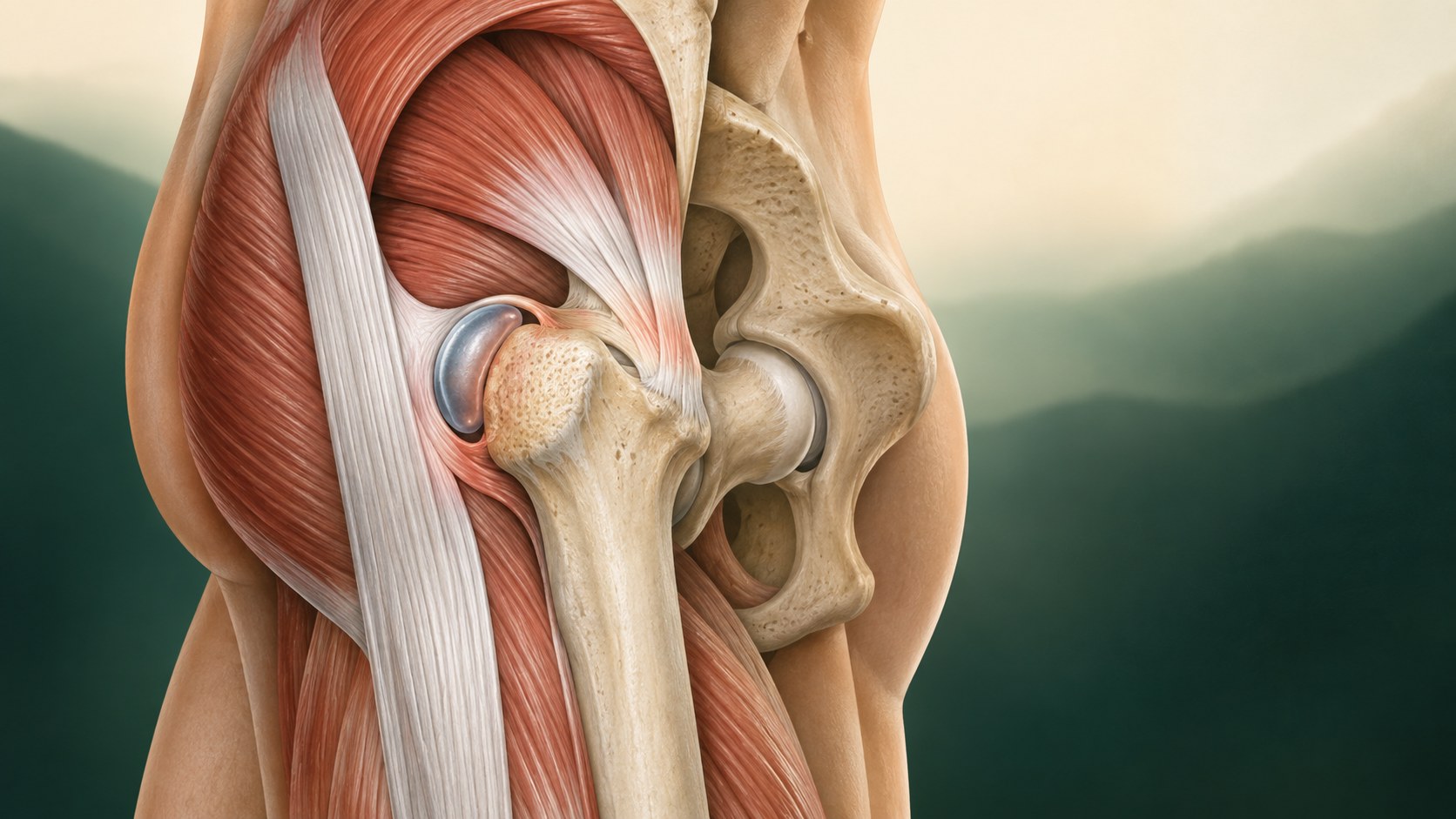
The gluteus medius and minimus tendons attach around the greater trochanter. Bursae reduce friction nearby. Tendon compression, load intolerance, and local tissue sensitivity can contribute, but hip joint disease and referred spine pain can produce a similar region of symptoms.
History and examination first
How the diagnosis is evaluated
Evaluation maps tenderness and symptom behavior, checks hip strength and single-leg control, and screens the hip joint and lumbar spine. Ultrasound or MRI may help when a tendon tear or another target would change care.
Keep the differential open
What else can look similar
A diagnosis is safer when the common alternatives are considered instead of treating pain location as proof.
- Hip osteoarthritis or other intra-articular disease
- Lumbar radiculopathy or referred low-back pain
- Gluteal tendon tear
- Other periarticular hip pain
Core care
Conservative care remains the foundation
Care should build capacity and reduce unnecessary protection while staying responsive to the exact diagnosis and symptom behavior.
Reduce sustained compressive positions such as prolonged side-lying on the painful hip
Progress hip-abductor loading and movement control
Adjust walking, stairs, and training load without defaulting to complete rest
Address lumbar or hip-joint findings when they better explain symptoms
Evidence at a glance
Evidence at a glance
The evidence is not a scoreboard. Comparator choice, follow-up, patient selection, and the exact tissue problem can change the result.
Exercise and education have the strongest support as first-line care, with better long-term global improvement than corticosteroid injection in pooled evidence.
Corticosteroid injection may provide short-term relief for some patients, but the benefit often narrows over time.
PRP evidence conflicts. Older corticosteroid-comparator trials were favorable, while a 2025 placebo-controlled trial found no significant benefit through six months.
Decision quality matters
Evidence, limits, and who it may fit
Procedure consideration requires a confirmed diagnosis, correlation between symptoms and anatomy, review of prior care, contraindications, alternatives, goals, and the limits of the diagnosis-specific evidence. Relationship membership does not establish candidacy.
- Exercise and education have the strongest support as first-line care, with better long-term global improvement than corticosteroid injection in pooled evidence.
- Corticosteroid injection may provide short-term relief for some patients, but the benefit often narrows over time.
- PRP evidence conflicts. Older corticosteroid-comparator trials were favorable, while a 2025 placebo-controlled trial found no significant benefit through six months.
Referral and urgent signs
When another or urgent evaluation matters
Some findings should redirect the plan toward urgent care, another specialist, or a different diagnosis.
- Inability to bear weight after trauma
- Fever, a hot swollen joint, or rapidly progressive symptoms
- Progressive leg weakness, bowel or bladder change, or another neurologic emergency
The visit
What to expect at an evaluation
The visit should narrow the diagnosis, clarify what has already been tried, and identify the next useful decision rather than defaulting to an injection. That may mean refining a rehabilitation plan, obtaining imaging only when it would change care, discussing a procedure with its evidence limits, or arranging another specialist evaluation.
Distinguish tendon-region pain from hip-joint and spine referral
Assess hip abductor strength and movement control
Match rehabilitation or any injection discussion to the suspected target
Common questions
Greater Trochanteric Pain Syndrome FAQ
These answers are educational and cannot determine an individual diagnosis or treatment plan.
Is GTPS the same as bursitis?
No. Bursal irritation can contribute, but GTPS is a broader clinical syndrome. Gluteal tendon pathology, tendon compression, strength and movement demands, the hip joint, and referred pain can all matter. The evaluation should identify which findings best explain the individual pattern before a target-specific treatment is discussed.
Is gluteal tendinopathy always present?
No. It is an important possible driver, but GTPS is broader. Evaluation should also consider the hip joint, lumbar spine, and other lateral-hip structures.
Are a bursa injection and PRP interchangeable?
No. They target different clinical questions. A bursa or periarticular injection and a tendon-directed PRP discussion should not be presented as equivalent.
Diagnosis before procedure
Start with a careful evaluation
The next step is to confirm the pain source, review prior care, and choose a plan that fits the diagnosis and your goals.