
The symptom region is a starting point, not a diagnosis.
Hip & thigh conditions
Hip Pain
Hip pain is a description of where it hurts, not a diagnosis. A deep ache in the groin when walking or putting on shoes, a sore outer hip that hurts to lie on, and pain in the buttock that travels down the leg can all be called "hip pain", but they come from different sources and need different care.
Quick orientation
What to know first
History and examination determine which anatomy and tests matter.
Urgent, neurologic, infectious, vascular, traumatic, and systemic causes stay visible until reasonably excluded.
What we may consider next
How we may treat this
Treatments that may be considered after an evaluation. Which option, if any, fits depends on the cause of your pain, your examination, prior treatment and your health history; your physician will explain the benefits, limits and risks.
Establish first
Diagnostic or prognostic steps help clarify the pain generator or whether a later option fits.
Diagnostic / prognostic step
Hip Articular Branch Block
Diagnostic block for suspected hip joint pain; it predicts RFA results only partly
Options that may be considered
These are options, not required steps. Selection depends on the diagnosis and individual review.
Treatment option
Hip Intra-Articular Injection
Diagnostic or short-term option for selected hip joint pain, including arthritis; it does not restore cartilage
Treatment option
Trochanteric Bursa / Periarticular Injection
For selected outer hip (greater trochanteric) pain, which often involves the gluteal tendons rather than the bursa alone
May come later
A later procedure is considered only when evaluation and the response to earlier steps support it.
Later treatment option
Hip Articular Branch Radiofrequency Ablation
An emerging option for selected hip arthritis pain that has not responded to other care; long-term evidence is limited; not a replacement for hip replacement surgery
Choose the guide that matches your question
Explore the specific guides.
Use these links to learn about related symptoms, conditions, and treatments. An individual evaluation is still needed to determine a diagnosis or whether a treatment may be appropriate.
Clinical guide
Hip Osteoarthritis
Hip-joint osteoarthritis symptoms, evaluation, conservative care, and procedure considerations.
Open this guideClinical guide
Greater Trochanteric Pain Syndrome (Lateral Hip Pain)
The broader lateral-hip pain syndrome, including gluteal tendon pathology without treating it as a literal synonym.
Open this guideSymptom guide
Pelvic & Groin Pain
Combined pelvic-and-groin symptom orientation with referral boundaries and named neuralgia pathways.
Open this guideSymptoms are clues, not a diagnosis
What hip pain can feel like
Symptoms help define a syndrome, but they do not confirm which structure is responsible. Distribution, timing, aggravating factors, neurologic findings, function, and important alternatives all shape the evaluation.
A deep ache in the groin or front of the hip, stiffness after rest, and trouble with shoes, socks or getting out of a car: suggests the hip joint itself, most often hip osteoarthritis.
Pain on the outer hip that hurts to lie on, climb stairs or stand on one leg: suggests greater trochanteric pain syndrome, which usually involves the gluteal tendons.
Pain in the buttock that travels down the back of the leg, sometimes below the knee, with numbness or tingling: suggests the lower back (sciatica) rather than the hip.
Pain low in the buttock near the dimple of the lower back, worse with sitting or rolling in bed: suggests the sacroiliac joint.
Groin pain with a bulge, or pain in the lower abdomen or pelvis: needs evaluation for a hernia or a pelvic source.
Relevant anatomy
What causes hip pain
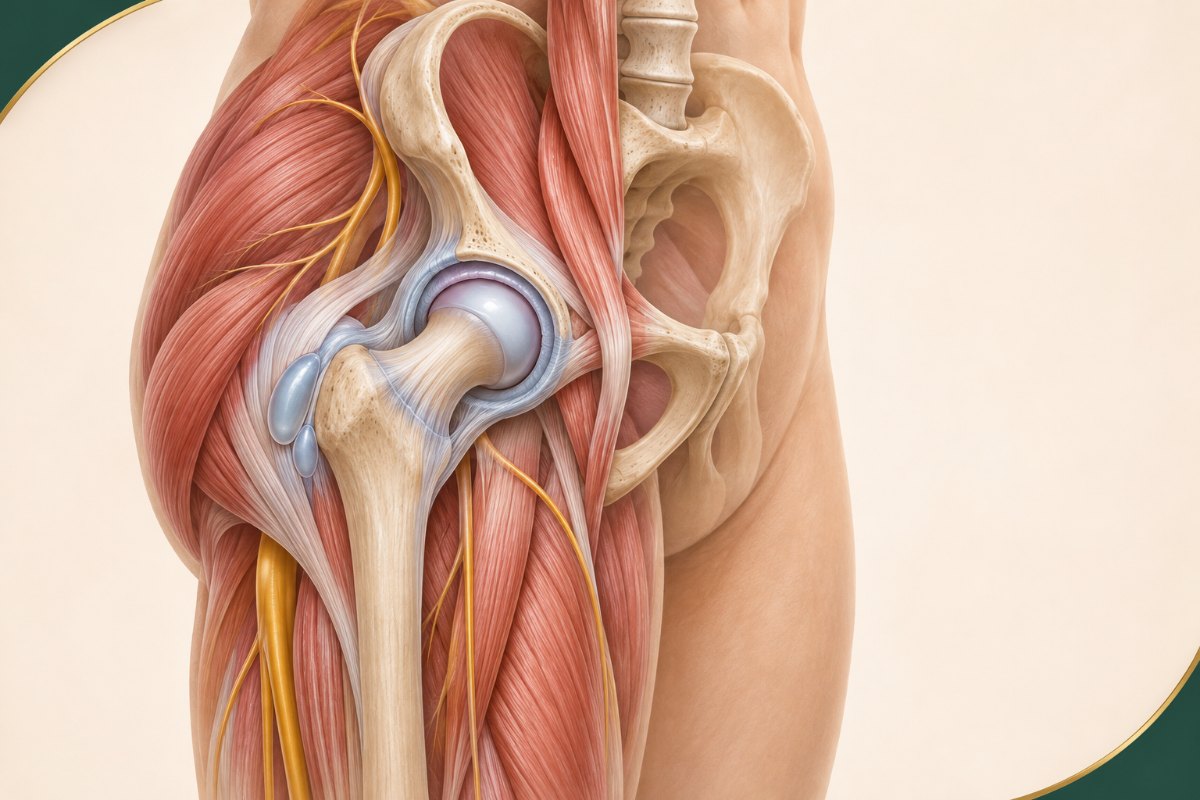
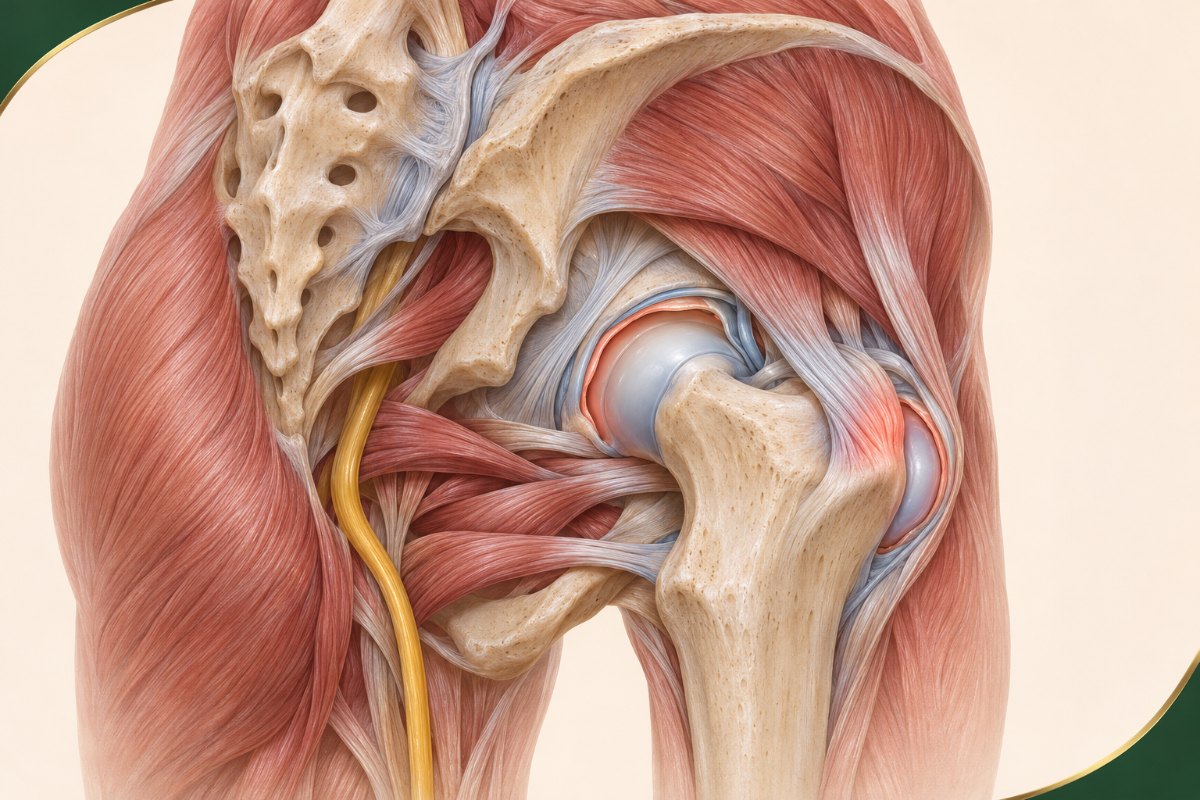
The hip joint is a ball and socket deep in the groin, surrounded by strong muscles and tendons. The gluteal tendons attach on the outer hip over a bony point (the greater trochanter), with a bursa nearby. The lower back, the sacroiliac joint and nerves of the pelvis can all send pain to the hip area, so where it hurts does not always show where it starts.
History and examination first
How hip pain is diagnosed
The first visit separates these patterns: where the pain is (groin, outer hip or buttock), what brings it on, and whether there is back pain, numbness or weakness. The examination checks the hip's movement, the outer hip tendons, the lower back, the sacroiliac joint and the nerves of the leg. X-rays of the hip and pelvis are usually the first image. MRI or ultrasound is used when the result would change care, for example when X-rays are normal but a joint or tendon problem is still suspected.
Keep the differential open
Conditions that can feel like hip pain
Keep common and serious alternatives open until the evidence supports a narrower conclusion.
Local joint, tendon, muscle, ligament, bursa, bone, or soft-tissue disorders
Spinal referral, nerve-root, plexus, or peripheral-nerve disorders
Traumatic, infectious, inflammatory, vascular, metabolic, medication-related, or oncologic causes
Core care
Non-surgical care for hip pain
Procedure discussions belong inside a broader plan that protects neurologic function and daily activity.
Education, pacing, sleep and activity strategies matched to the diagnosis
Rehabilitation focused on mobility, strength, tolerance, and function when safe
Medication and comorbidity review with the appropriate clinician
Reassessment when symptoms, neurologic findings, function, or response changes
Evidence at a glance
Evidence at a glance
Evidence strength, comparator, follow-up, and selection affect interpretation.
Guidelines advise X-rays as the first image for chronic hip pain, with MRI or ultrasound chosen for the specific question (ACR Appropriateness Criteria, Chronic Hip Pain, 2022).
For hip osteoarthritis, exercise therapy and weight management are core treatments; a joint corticosteroid injection could be considered for short-term relief of pain and function; hyaluronic acid is not recommended (AAOS hip osteoarthritis guideline, 2023).
For outer hip pain (greater trochanteric pain syndrome), exercise gives better long-term improvement than a corticosteroid injection; an injection can give short-term relief (Kjeldsen et al. meta-analysis, 2024; Wang et al. meta-analysis, 2022).
Decision quality matters
Evidence, limits, and who it may fit
A listed option does not establish candidacy. Diagnosis, anatomy, prior care, risk, alternatives, goals, and evidence must align.
Referral and urgent signs
When hip pain needs urgent care
These findings can change the timing or destination of care.
A fall or injury followed by hip or groin pain and inability to bear weight: possible hip fracture.
A hot, swollen or very painful hip with fever or feeling unwell, or after a recent joint injection or surgery: possible joint infection.
Hip or buttock pain with loss of bladder or bowel control, numbness in the groin or saddle area, or rapidly worsening leg weakness: possible cauda equina syndrome.
New swelling of one leg with chest pain or shortness of breath: possible blood clot.
The visit
Your first visit for hip pain
The visit should narrow the diagnosis, identify safety and referral needs, review imaging and prior care in context, and choose the next useful decision. The clinician should explain uncertainty and what a treatment is expected to add before it is performed.
Define the location, timing, triggers, sensory features, functional effect, prior injury, and prior care
Examine the relevant joint, spine, muscles, nerves, circulation, gait, strength, sensation, and reflexes as appropriate
Use imaging, electrodiagnostic testing, laboratory work, or referral only when it answers a clinical question
Choose education, rehabilitation, medical care, further diagnostic work, a selected procedure discussion, or referral based on the working diagnosis
Common questions
Hip Pain FAQ
These answers are educational and cannot determine an individual diagnosis or treatment plan.
When should hip pain be checked by a specialist?
When it lasts more than a few weeks, keeps returning, limits walking, stairs or sleep, or comes with back pain, numbness or weakness. Seek emergency care for hip pain after a fall with inability to bear weight, a hot swollen hip with fever, or loss of bladder or bowel control.
Is my hip pain coming from my hip or my back?
It can be either. A deep groin ache that is worse with walking or turning the leg points to the hip joint. Buttock pain that travels down the leg, especially with numbness or tingling, points to the lower back. The examination checks the hip, the back and the sacroiliac joint so the right source is treated.
What treatments are available besides hip replacement?
Exercise therapy, weight management and medicines help many hip problems. For selected patients, a hip joint injection, an outer hip (trochanteric) injection or a hip articular branch block may be discussed after an evaluation. If the block helps, radiofrequency ablation of the same nerves may be discussed.
Where can I be seen for hip pain?
New-patient visits are available at the Allen office, Monday to Friday, and at the Wylie office on Tuesdays. Ultrasound-guided outer hip (trochanteric) injections are available at both offices; hip joint injections, hip articular branch blocks and radiofrequency ablation are performed in Allen.
Diagnosis before procedure
See a pain specialist for hip pain
A focused evaluation can clarify the diagnosis, important alternatives, and the next step that fits the clinical picture.