
The symptom region is a starting point, not a diagnosis.
Leg, ankle & foot conditions
Foot Pain
Foot pain is a description of where it hurts, not a diagnosis. A sharp heel pain with the first steps in the morning, burning or numbness in both feet at night, tingling along the inner ankle and sole, and pain at the ball of the foot can all be called "foot pain", but they come from different sources and need different care.
Quick orientation
What to know first
History and examination determine which anatomy and tests matter.
Urgent, neurologic, infectious, vascular, traumatic, and systemic causes stay visible until reasonably excluded.
What we may consider next
How we may treat this
Treatments that may be considered after an evaluation. Which option, if any, fits depends on the cause of your pain, your examination, prior treatment and your health history; your physician will explain the benefits, limits and risks.
Establish first
Diagnostic or prognostic steps help clarify the pain generator or whether a later option fits.
Diagnostic / prognostic step
Ankle Peripheral Nerve Block
For selected nerve-related foot or ankle pain; often diagnostic or temporary
Diagnostic / prognostic step
Tibial Nerve Block
For suspected tibial nerve pain, including selected tarsal tunnel cases; it does not correct the compression
Options that may be considered
These are options, not required steps. Selection depends on the diagnosis and individual review.
Treatment option
Platelet-Rich Plasma (PRP)
May be considered for persistent plantar fasciitis; protocols and results vary
Choose the guide that matches your question
Explore the specific guides.
Use these links to learn about related symptoms, conditions, and treatments. An individual evaluation is still needed to determine a diagnosis or whether a treatment may be appropriate.
Clinical guide
Plantar Fasciitis
Plantar heel pain consistent with plantar fasciitis, differential diagnosis, and treatment pathways.
Open this guideClinical guide
Peripheral Neuropathy
Peripheral neuropathy symptoms, cause-oriented evaluation, safety considerations, and treatment pathways.
Open this guideClinical guide
Painful Diabetic Neuropathy
Painful diabetic peripheral neuropathy, evaluation, risk-aware management, and treatment pathways.
Open this guideClinical guide
Tarsal Tunnel Syndrome
Symptoms, differential diagnosis, and treatment pathways for tibial nerve compression within the tarsal tunnel.
Open this guideSymptoms are clues, not a diagnosis
What foot pain can feel like
Symptoms help define a syndrome, but they do not confirm which structure is responsible. Distribution, timing, aggravating factors, neurologic findings, function, and important alternatives all shape the evaluation.
Sharp pain under the heel with the first steps in the morning or after sitting, easing as you walk: suggests plantar fasciitis (plantar heel pain).
Burning, tingling or numbness in both feet, often worse at night, sometimes with loss of feeling: suggests peripheral neuropathy, most often from diabetes.
Burning or tingling along the inner ankle and sole of one foot, worse with standing or walking: suggests tarsal tunnel syndrome (tibial nerve).
Pain or a "pebble in the shoe" feeling at the ball of the foot, sometimes with numb toes: suggests a forefoot nerve or joint problem such as a Morton neuroma.
Aching and stiffness of the ankle or midfoot joints with swelling after activity: suggests arthritis.
Pain that starts in the lower back and travels down the leg into the foot: suggests a pinched nerve in the back (sciatica).
Relevant anatomy
What causes foot pain
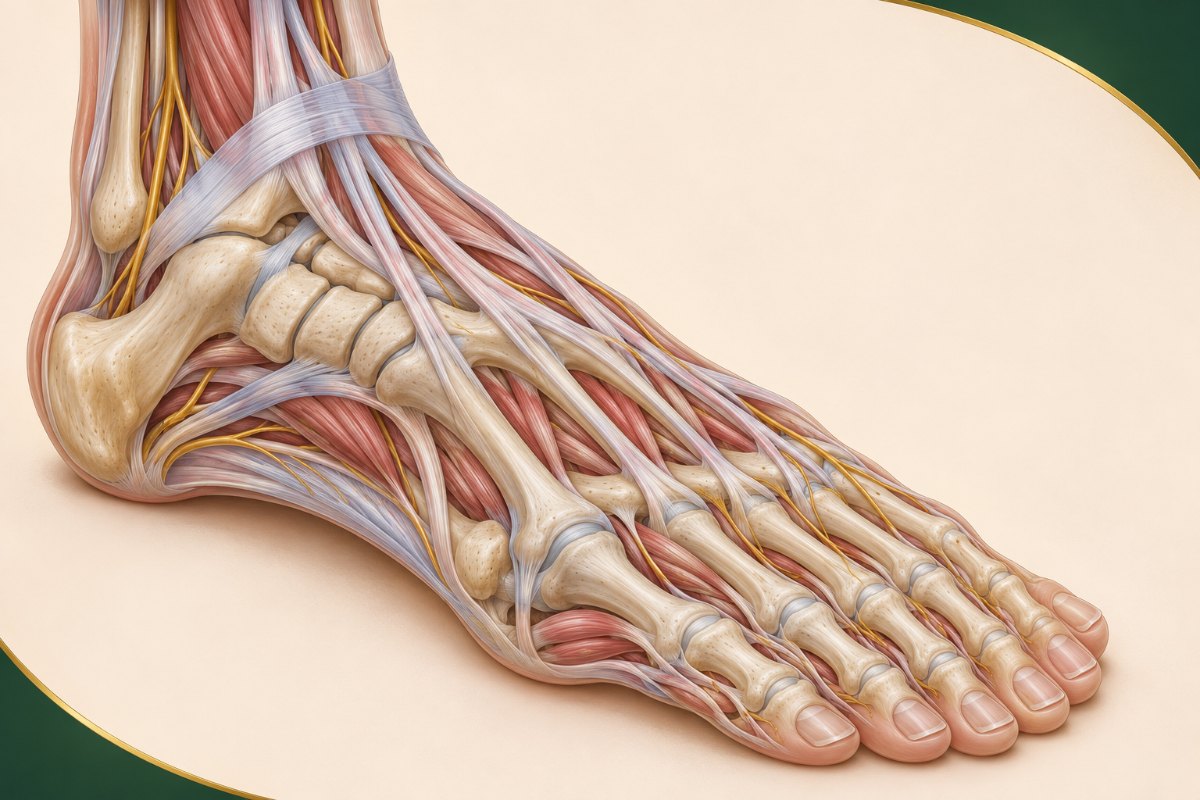
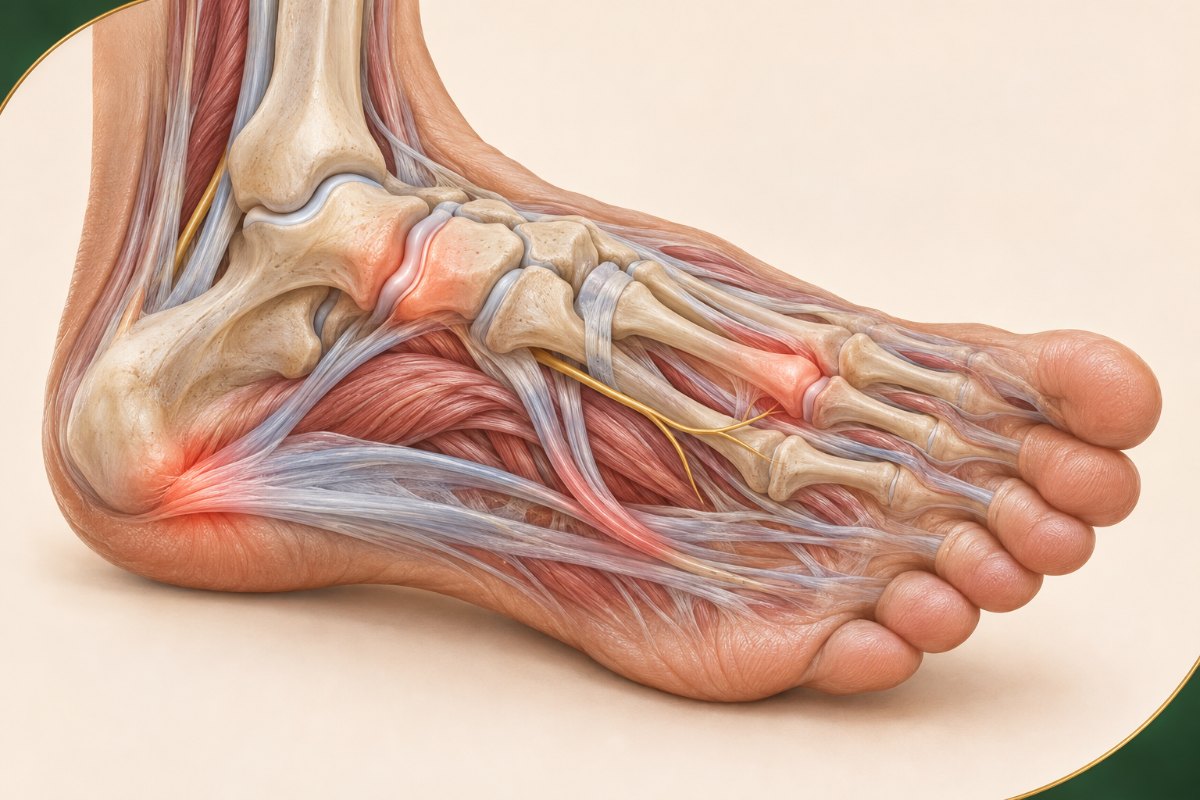
The foot has 26 bones and many small joints, held by the plantar fascia (a thick band under the sole) and the tendons that move the ankle and toes. The tibial nerve passes behind the inner ankle through the tarsal tunnel and divides to supply the sole. The longest nerves in the body end in the feet, so conditions that affect nerves throughout the body, such as diabetes, often show up there first.
History and examination first
How foot pain is diagnosed
The first visit separates these patterns: where the pain is, when it is worst, whether one or both feet are affected, and whether there is numbness, weakness or back pain. The examination checks the joints, the plantar fascia and tendons, sensation and strength, the reflexes, the pulses and the skin, and looks at the lower back when symptoms travel. X-rays are used when a bone or joint problem is suspected. Nerve conduction studies are used when the pattern of numbness needs to be confirmed or another cause ruled out.
Keep the differential open
Conditions that can feel like foot pain
Keep common and serious alternatives open until the evidence supports a narrower conclusion.
Local joint, tendon, muscle, ligament, bursa, bone, or soft-tissue disorders
Spinal referral, nerve-root, plexus, or peripheral-nerve disorders
Traumatic, infectious, inflammatory, vascular, metabolic, medication-related, or oncologic causes
Core care
Non-surgical care for foot pain
Procedure discussions belong inside a broader plan that protects neurologic function and daily activity.
Education, pacing, sleep and activity strategies matched to the diagnosis
Rehabilitation focused on mobility, strength, tolerance, and function when safe
Medication and comorbidity review with the appropriate clinician
Reassessment when symptoms, neurologic findings, function, or response changes
Evidence at a glance
Evidence at a glance
Evidence strength, comparator, follow-up, and selection affect interpretation.
Guidelines advise X-rays as the first image for chronic foot pain, with ultrasound or MRI chosen for the specific question (ACR Appropriateness Criteria, Chronic Foot Pain, 2020).
For plantar heel pain, stretching, manual therapy, taping, orthoses and night splints are core treatments (APTA/JOSPT heel pain guideline, revision 2023).
For diabetic neuropathy, an annual foot examination is advised, and medicines such as pregabalin or duloxetine are first choices for nerve pain (ADA Standards of Care, 2025).
For painful diabetic neuropathy that has not responded to other care, a randomized trial found more pain relief at six months with 10 kHz spinal cord stimulation added to usual medical care than with usual care alone. After six months, patients could switch to stimulation, and relief continued through 24 months in those who had it, without a separate usual-care group for comparison. Patients and doctors knew which treatment was given, and about 3% of systems were removed for infection (SENZA-PDN, Petersen et al., 2023).
Decision quality matters
Evidence, limits, and who it may fit
A listed option does not establish candidacy. Diagnosis, anatomy, prior care, risk, alternatives, goals, and evidence must align.
Referral and urgent signs
When foot pain needs urgent care
These findings can change the timing or destination of care.
A cold, pale, blue, rapidly swollen, or insensate foot; new weakness; or loss of pulse
A hot red foot, fever, spreading redness, open wound, drainage, or ulcer, especially with diabetes or neuropathy
Major trauma, deformity, inability to bear weight, or rapidly progressive symptoms
The visit
Your first visit for foot pain
The visit should narrow the diagnosis, identify safety and referral needs, review imaging and prior care in context, and choose the next useful decision. The clinician should explain uncertainty and what a treatment is expected to add before it is performed.
Define the location, timing, triggers, sensory features, functional effect, prior injury, and prior care
Examine the relevant joint, spine, muscles, nerves, circulation, gait, strength, sensation, and reflexes as appropriate
Use imaging, electrodiagnostic testing, laboratory work, or referral only when it answers a clinical question
Choose education, rehabilitation, medical care, further diagnostic work, a selected procedure discussion, or referral based on the working diagnosis
Common questions
Foot Pain FAQ
These answers are educational and cannot determine an individual diagnosis or treatment plan.
When should foot pain be checked by a specialist?
When it lasts more than a few weeks, keeps you from walking or standing, wakes you at night, or comes with numbness, burning or weakness. People with diabetes should have any new foot pain, numbness, sore or color change checked promptly. Seek emergency care for a cold, pale or blue foot, a hot red foot with fever or an open sore, or a foot you cannot stand on after an injury.
Why do my feet burn at night?
Burning, tingling or numbness in both feet, often worse at night, is a common sign of peripheral neuropathy, frequently from diabetes. Other causes include vitamin deficiencies, medicines and nerve compression. The examination and nerve tests help find the cause so the right treatment can be chosen.
What treatments are available for foot pain?
Stretching, supportive footwear, orthoses and medicines help many foot problems. For selected patients, an ankle or tibial nerve block may be discussed after an evaluation, and for painful diabetic neuropathy that has not responded to other care, spinal cord stimulation may be discussed, with a trial first.
Where can I be seen for foot pain?
New-patient visits are available at the Allen office, Monday to Friday, and at the Wylie office on Tuesdays. Ultrasound-guided ankle blocks are available at both offices; spinal cord stimulation is performed in Allen.
Diagnosis before procedure
See a pain specialist for foot pain
A focused evaluation can clarify the diagnosis, important alternatives, and the next step that fits the clinical picture.